
How BeyondMed Closed Dozens of Enterprise Deals and Hundreds of Thousands in ARR Over 14+ Months of AI-Powered Cold Outbound Into Enterprise HR and Benefits Buyers
BeyondMed is a HealthTech founder-led operator selling employee health perks into enterprise HR, benefits, and broker decision-makers. We have run their cold outbound continuously for 14+ months. The engine that started as a system rebuild (deliverability fix, 5x reply-rate lift, lead-volume doubling inside the first month) has continued to compound into dozens of closed enterprise deals worth hundreds of thousands in ARR. This case study covers the enterprise-buyer side specifically. The provider-network side BeyondMed runs alongside it is documented in a separate provider-network case study.
Client Overview
BeyondMed is a HealthTech operator selling employee health perks into US enterprise companies. Their primary buyer side is HR and Benefits decision-makers, brokers who advise enterprise clients on benefits stacks, and executives at companies large enough to offer structured employee wellness programs. Greg, the founder, originally ran outbound himself, with prior agency experience and a working system that had stopped working: declining campaign performance, Microsoft deliverability updates breaking inbox placement, bounce rates climbing even after running ZeroBounce validation, reply rates stuck between 0.5% and 1.5%, and lead volume capped at 20-30 per month.
BeyondMed engaged Danish Lead Co. to rebuild the outbound stack from the deliverability layer up, with the explicit goal of removing the founder from day-to-day campaign management while moving the system into a higher-output, higher-quality regime. Inside the first month, reply rates lifted to 4-9% and lead volume doubled to 50-65 per month. Over the 14+ months that followed, the system has compounded into dozens of closed enterprise deals and hundreds of thousands in ARR.
What this case study covers: the enterprise-HR-buyer side of BeyondMed's outbound system. BeyondMed also runs a parallel provider-network outbound system to grow their HealthTech provider supply. That second build is documented in the BeyondMed provider-network case study. The two systems run on isolated infrastructure and target completely different audiences.
What HR and benefits leaders look up before they evaluate an employee health perks platform
Ideal Customer Profile (ICP) for the enterprise HR side
How DLC built BeyondMed's enterprise-buyer outbound system
BeyondMed's old system had become unstable because four layers had drifted at once: deliverability infrastructure, data validation, persona-specific messaging, and founder-execution capacity. Patching one layer would have produced a short-term lift and a long-term flat line. The rebuild touched all four in parallel inside the first 30 days, and the system has carried the result for 14+ months since.
Week 1, deliverability rebuild
New domains, inbox rotation, Microsoft-update-resistant pools
Microsoft's 2024-2025 inbox-provider changes broke a lot of mid-2023-built outbound stacks, BeyondMed's included. The deliverability layer was rebuilt from new domains, with isolated warmed-inbox pools and rotation discipline tuned to current provider thresholds. Reply-rate floor lifted inside the first two weeks because the messages were finally landing where they could be read.
Result: bounce-rate floor dropped, inbox placement stabilised, and the messaging finally had a chance to perform on its merits.
Week 1-2, data layer rebuild
Multi-layer validation beyond ZeroBounce, before AI personalization runs
Single-tool email validation is insufficient at enterprise scale. The rebuild layered Clay for enrichment workflows, Apollo for the contact database, FI Navigator for HR and benefits vertical intelligence, and BuiltWith for technology-stack signal, with a manual QA pass on the merged dataset before AI personalization touched it. The order is: enrich, validate, QA, then write. Inverting that order is what produces the bounce-rate climbs that single-tool stacks see.
Result: bounce rates collapsed against the previous baseline; reply rates lifted from 0.5-1.5% to 4-9% inside the first month.
Week 2-3, messaging rewrite
Persona-specific angles for HR, brokers, and executives
The old copy averaged all enterprise HR readers into one beige opener. The rewrite split into three persona tracks: HR leaders saw benefits-ROI and engagement-rate framing; brokers saw revenue-share and joint-client positioning; executives saw cost-transparency and employee-retention framing. Dynamic personalization wraps the persona track in company size, region, and existing perks-stack signal, all derived from the QA'd enrichment layer.
Result: reply rates compounded the deliverability lift with persona-fit lift; lead volume doubled from 20-30 per month to 50-65 per month inside the first 30 days.
Week 3-4, founder removal
Greg out of daily execution, system runs on its own infrastructure
The brief explicitly included removing Greg from daily campaign operation. The closing phase wired the system so DLC owns inbox health, deliverability monitoring, list refresh, copy testing, and reply triage, with Greg seeing only qualified appointments routed to his calendar. Founder time gets reinvested into closing the dozens of enterprise deals the system has surfaced over the 14 months since.
Result: Greg fully removed from daily campaign management; the system has continued running for 14+ months with compounding output.
The structural insight
"Deliverability + validated data + persona-specific copy + founder-out-of-execution are not four independent levers. They are one system. Fixing one without the others produces a temporary lift and a long-term plateau. Fixing all four at once is what produced the 5x reply-rate jump in 30 days and the 14 months of compounding ARR since."
Tools and stack used
Each tool covers a failure mode the others would not catch. Together they make the enrichment-then-QA-then-AI personalization pattern operational at the volume the enterprise pipeline requires. The full reasoning behind this tooling stack is covered in our 2026 prospecting tools guide.
"In just one month, BeyondMed scaled from 20-30 leads a month to 50-65, while reply rates jumped from around 1% to 4-9%. We rebuilt their entire outbound system, fixed deliverability, and created a scalable lead engine, removing the founder from day-to-day campaign management."
, Greg, Founder of BeyondMedVerified Trustpilot review
Greg's review of working with Danish Lead Co.
BeyondMed has now worked with Danish Lead Co. for 14+ months on this enterprise outbound system. Greg posted a Trustpilot review documenting the engagement, the system rebuild, and the compounding pipeline outcome:
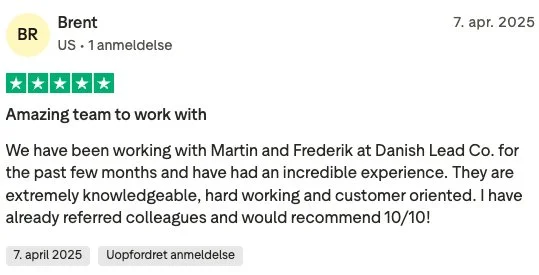
Trustpilot review submitted by Greg, Founder of BeyondMed.
What the build delivered (and continues to deliver after 14 months)
Most cold outbound case studies measure a 30-day or 60-day window. BeyondMed's enterprise system has been live continuously for 14+ months, so the durable result matters more than the initial spike. Both are documented below.
4-9%
Reply rates, up from 0.5-1.5% baseline
50-65
Leads per month, up from 20-30
14+
Months of compounding pipeline
Dozens
Enterprise deals closed from DLC-sourced leads
Hundreds of $K
In ARR closed over the 14-month engagement
Founder-out
Greg removed from daily campaign management
Scope note
These numbers cover the enterprise-buyer side of BeyondMed's outbound only. The provider-network side runs on isolated infrastructure with separate metrics and is documented in the BeyondMed provider-network case study. ARR figures cited here are from enterprise deals closed by BeyondMed off DLC-sourced leads over the 14+ months of engagement.
Before vs. after the rebuild
Strong fit vs. less suitable for this play
Strong fit
- Founder-led HealthTech, HR-Tech, and Benefits-Tech operators selling enterprise with a 60-120 day enterprise cycle
- Operators with a previously working outbound stack that has decayed (deliverability, data, copy, or all three at once)
- Sellers whose buyer split into clear personas (HR, broker, executive) that warrant separate angle tracks
- Founders willing to be removed from daily campaign management and to let the system run on owned infrastructure
- Multi-year category bets where the case study's value is durable performance, not a one-quarter spike
Less suitable
- Operators expecting a 30-day pilot to be the full case (the durable 14-month compounding is the case here)
- Sellers without distinct buyer personas (HR vs. broker vs. executive) for the angle tracks to address
- Founders who want to remain in daily campaign management (the founder-out model is structural, not optional)
- Categories where the buying cycle is too short for compounding pipeline to dominate over surface engagement metrics
- Operators uncomfortable investing in deliverability infrastructure (new domains, inbox rotation, isolated pools)
Five lessons from the BeyondMed enterprise-HR build
1. Deliverability is the foundation everything else stands on.
Domain reputation, inbox rotation, and pool isolation are not optional infrastructure. Microsoft's 2024-2025 inbox-provider changes broke a generation of cold-outbound stacks. The rebuild starts here, not at copy.
2. Data layering across enrichment tools is what cuts bounce rates, not bigger validation budgets.
Clay + Apollo + FI Navigator + BuiltWith with manual QA before AI personalization runs is structurally different from running ZeroBounce harder. Single-tool validation produces single-tool failure modes; multi-tool layered enrichment produces resilient data.
3. Persona-specific angles compound deliverability gains. Generic openers waste them.
HR leaders, brokers, and executives are not the same buyer with three different titles. They have different filters, different objections, and different proof-point preferences. Splitting the angle tracks is how the reply-rate lift was 5x rather than 2x.
4. Founder removal from daily execution is the model, not the side-effect.
Greg's time is the constraint that limits how many enterprise deals BeyondMed can close. Building the system so the founder is out of daily campaign management is what frees that constraint. Closing capacity is the binding bottleneck; outbound system management never should be.
5. The case study is the 14 months, not the 30 days.
The first-month numbers (5x reply rates, double the lead volume) are real, but they are not the case. The case is 14+ months of compounding pipeline, dozens of closed enterprise deals, and hundreds of thousands in ARR. Cold outbound's value compounds when the infrastructure is durable; a 30-day spike on broken infrastructure is what the previous stack was producing.
Continue exploring
Want a durable enterprise-buyer outbound system that compounds for years, not quarters?
If your offer is HealthTech, HR-Tech, Benefits-Tech, or any enterprise category with a 60-120 day cycle and distinct buyer personas, the BeyondMed playbook can be adapted. We start by auditing your current deliverability state, mapping your enrichment layer against the failure modes single-tool validation cannot catch, splitting your buyer personas into angle tracks, and wiring the system so the founder is structurally out of daily execution.
Frequently asked questions
Common questions about running enterprise HR outbound for a HealthTech operator, the rebuild pattern that produced BeyondMed's 5x reply-rate lift, and the 14-month compounding outcome.
How does cold outbound work for an enterprise HR + Benefits HealthTech operator?
Enterprise HR outbound works when the deliverability infrastructure is engineered (domains, rotation, isolated warmed pools), the data layer is multi-source and QA'd before AI personalization touches it (Clay, Apollo, FI Navigator, BuiltWith with manual QA), and the messaging splits into persona-specific tracks for HR, brokers, and executives. The BeyondMed rebuild applied all three disciplines and lifted reply rates from 0.5-1.5% to 4-9% inside one month, with lead volume doubling from 20-30 to 50-65 per month.
Why did the previous outbound stack stop working?
Four reasons compounded. Microsoft's 2024-2025 inbox-provider updates degraded the deliverability of mid-2023-built domain stacks. Single-tool data validation (ZeroBounce alone) stopped clearing the bounce-rate threshold modern providers expect. Generic messaging averaged HR, broker, and executive personas into one beige opener. And the founder was carrying daily campaign management on top of closing enterprise deals, which capped output. Fixing one of the four would have produced a short-term lift; fixing all four is what produced 14 months of compounding pipeline.
What does the deliverability rebuild involve specifically?
New domains brought in fresh against the current inbox-provider rules, fully warmed inbox pools isolated by sending strategy, rotation discipline calibrated to provider thresholds, and continuous deliverability monitoring inside Smartlead. The result is reliable inbox placement that lets the messaging perform on its merits. Without it, even strong copy gets caught in spam filters and the case-study comparison is moot.
How is data validated beyond ZeroBounce?
The data pipeline runs Clay for enrichment workflows, Apollo for the global contact database, FI Navigator for HR and benefits vertical intelligence, and BuiltWith for tech-stack signal (HRIS deployment, existing wellness stack detection, perks-platform footprint). A manual QA pass runs on the merged dataset before any AI personalization touches it. The order is: enrich, validate across multiple sources, QA, then write per-recipient copy.
What are the persona tracks and how do they differ?
HR leaders see benefits-ROI and engagement-rate framing, because their evaluation is about justifying spend to a CFO and producing measurable employee engagement. Brokers see revenue-share and joint-client positioning, because adding BeyondMed to a benefits stack threatens the broker relationship unless the vendor is broker-friendly. Executives see cost-transparency and employee-retention framing, because the evaluation at that altitude is about P&L impact and talent strategy. Each track has its own opener, body, and proof-point ladder.
How long did it take to see the lift, and how long has it lasted?
The reply-rate lift (0.5-1.5% to 4-9%) and lead-volume doubling (20-30 to 50-65 per month) landed inside the first 30 days of the rebuild going live. The compounding outcome (dozens of closed enterprise deals, hundreds of thousands in ARR) has accumulated over the 14+ months that followed. The case study is the durable 14-month engagement, not the 30-day spike.
What did the Trustpilot review say about the work?
Greg, the founder of BeyondMed, submitted a Trustpilot review documenting the engagement. The review is embedded above and corroborates the rebuild pattern (deliverability fix, system rebuild, founder removal from execution) and the quantitative outcome (lead volume from 20-30 to 50-65, reply rates from around 1% to 4-9%). Third-party-platform review evidence is the floor under the case-study claims.
Why is the founder removed from daily campaign management?
Greg's closing capacity is the constraint that limits how many enterprise deals BeyondMed can convert. Daily campaign management (deliverability monitoring, list refresh, copy testing, reply triage) was consuming founder hours that should have been going to enterprise calls. Removing the founder from daily execution is what unlocked the dozens of closed deals over 14 months. The founder-out model is structural, not a convenience feature.
How does this case study differ from the BeyondMed provider-network case study?
This case study covers the enterprise HR + Benefits buyer side of BeyondMed's outbound (companies buying wellness perks for their employees). The separate BeyondMed provider-network case study covers the supply side (recruiting healthcare providers into BeyondMed's network). The two systems run on isolated infrastructure, target completely different audiences, and produce different output metrics. They are presented as separate case studies because mixing them in one document would dilute both.
Can Danish Lead Co. build a similar durable enterprise outbound system for our HealthTech or B2B service?
Yes, when your offer is enterprise-scoped with a 60-120 day cycle, your addressable buyer splits into distinct personas (such as HR, broker, executive in BeyondMed's case), and you have a founder or operator willing to be removed from daily campaign management to focus on closing. We start with a deliverability audit, then map your enrichment layer against single-tool validation failure modes, then split your buyer personas into angle tracks, then wire the system so the founder is structurally out of execution. Book a call via danishleadco.io/book-a-demo if your business fits that profile.
