
How Appointwise Added a Predictable Outbound Channel on Top of Paid Ads
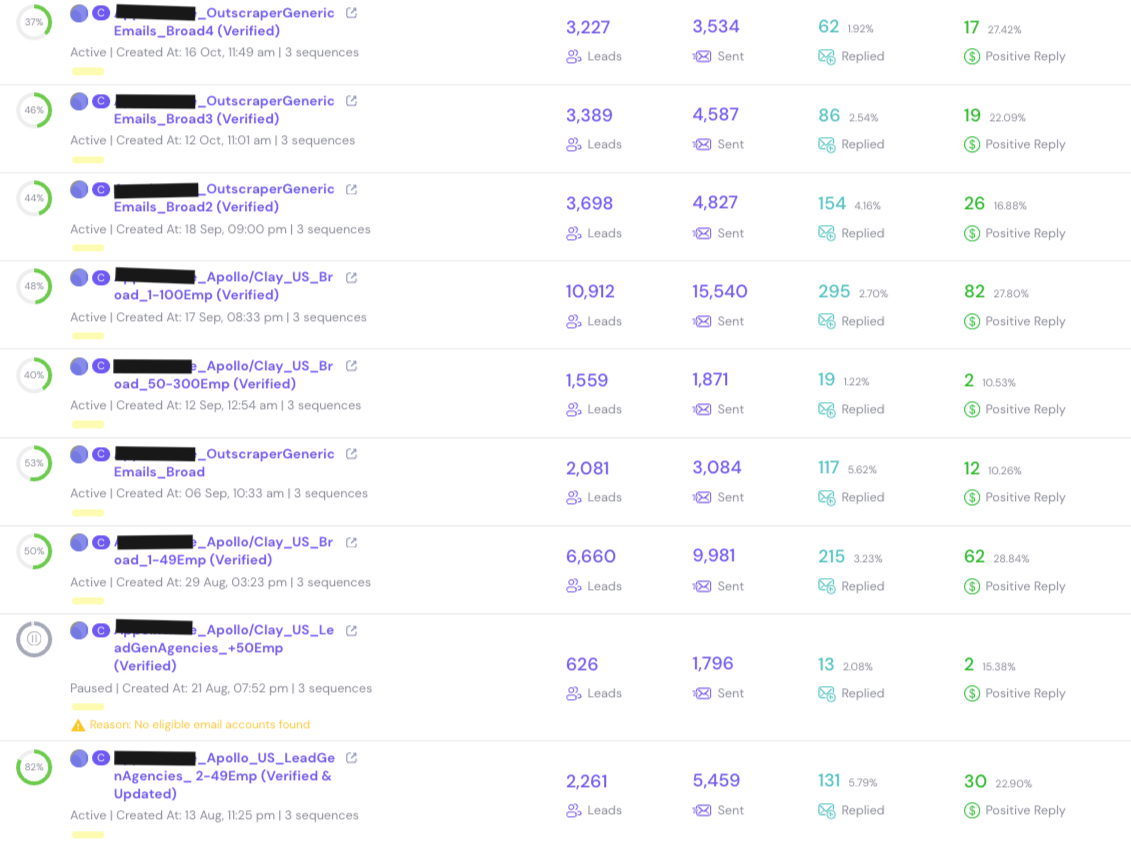
Dashboard view showing outbound campaign performance metrics across 10 B2B SaaS lead generation sequences, including leads, emails sent, reply rates, and positive responses.
Client Overview
Company: Appointwise (appointwise.io)
Industry: B2B SaaS / Appointment Automation
Team Size: 10–50 employees
ICP: Service businesses already using GoHighLevel (GHL) — prioritised further by those actively running Facebook/Instagram ads
Goal: Increase SaaS sign-ups and demo bookings on top of a channel mix that was already working (paid ads), without adding headcount.
What They Were Doing Before (and Why It Wasn’t Enough)
Appointwise wasn’t in a “nothing works” situation.
They were already driving demand through paid ads — but they wanted more predictable volume and a way to reach the exact type of business they perform best with, without relying solely on ad performance or constantly increasing spend.
They had also experimented with outbound internally, but ran into the usual issues:
- Time + execution load: prospecting and sending consistently took too much internal bandwidth
- Relevance ceiling: without the right signals, targeting drifted into “close enough” lists
- Deliverability limits: scaling volume safely required infrastructure they didn’t have in place
- Inconsistent pipeline: results fluctuated depending on who was working on outbound that week
Outbound wasn’t the “new channel.”
The missing piece was a scalable, signal-led system that could run alongside ads and compound results.
Our Strategy: Use Paid Ads as a Signal (Not a Competitor)
Instead of treating outbound as a replacement for ads, we treated ads as a filter and personalisation trigger.
We built targeting around two stacked signals:
- They use GoHighLevel (hard ICP requirement)
- They run Facebook/Instagram ads (intent + budget proxy)
That let us open with a line that felt obvious and timely, e.g.:
“Saw you were running ads for {{icp}} — how do you follow up with those to turn them into bookings?”
This wasn’t “personalisation for the sake of it.”
It was a relevance hook tied directly to a business problem their ICP already cares about: turning paid demand into booked appointments.
What We Built (The Actual System)
We built a multi-campaign outbound engine targeting GHL users across the US and EU — segmented by service category and prioritised by ad activity.
1) ICP + Signal-Based Targeting
- Identified service businesses using GoHighLevel
- Layered on Meta ad activity as an additional qualifier and messaging trigger
- Segmented by niche to keep messaging tight and specific
2) Deliverability Infrastructure (So Scale Didn’t Break the Channel)
- Deployed 60+ warmed inboxes across verified domains
- Rotated sending to protect sender reputation and avoid domain burn
- Prioritised clean lists and stable sending patterns over “blast volume”
3) Messaging Designed to Convert, Not Impress
- Short emails
- One clear idea
- Soft CTAs focused on a quick fit-check (demo or sign-up)
- Hooks built around real workflow pain: leads come in… follow-up breaks… bookings don’t happen
4) Weekly Iteration Based on Real Reply Data
- Adjusted segments, hooks, and CTAs based on what produced positive replies
- Cut underperforming micro-segments early
- Doubled down on the best-performing service categories and angles
What Didn’t Work (and What We Cut)
A few things looked good on paper but didn’t hold up in the replies:
- Too-broad “service business” targeting lowered relevance and increased noise
- Generic SaaS value props underperformed compared to workflow-specific hooks (follow-up → bookings)
- Some niches required tighter segmentation to avoid sounding like “another automation tool”
This ended up being a net positive: once we tightened the segments and leaned into the ad + follow-up angle, reply quality improved.
Results
✅ 49,011 leads targeted
✅ 57,173 emails sent
✅ 1,120 replies received (~2.5% reply rate)
✅ 304 positive replies (~27.1% positive-to-reply conversion)
✅ Multiple direct SaaS sign-ups before sales engagement
Within weeks, Appointwise had an outbound system producing consistent, qualified conversations — giving them a second predictable growth lever alongside paid ads.
Client Feedback
“61 positive replies last week and 2 new sign-ups 🎉 This is exactly the consistency we needed.”
— Appointwise, Campaign Manager
Tools & Stack Used
Clay – enrichment, logic-based segmentation, personalisation triggers
Smartlead – email automation + deliverability control
Apollo – firmographic data + list building
Outscraper – GHL user scraping/validation
BuiltWith – tech stack detection and audience refinement
Key Learnings
- Signal-stacking beats “bigger lists.” GHL usage + Meta ad activity produced higher-quality conversations than broad SaaS targeting.
- Workflow hooks outperform feature hooks. “How do you turn ad leads into bookings?” beat generic product-led messaging.
- Deliverability is the scale constraint. Infrastructure mattered more than copy tweaks once volume increased.
When This Approach Would Not Be a Fit
This strategy is strongest when:
- Your ICP is tech-detectable (like GHL usage)
- Your buyers have a clear workflow pain
- You can segment tightly enough to keep the message specific
It’s a weaker fit if:
- Your TAM is tiny (you’ll burn through it quickly)
- Your offer is low-LTV / low-ACV (outbound economics don’t work)
- You can’t define a clear “trigger” or relevance signal
Next Steps
- Expand into additional service niches with bespoke segmentation
- Segment campaigns by adoption stage (trial, freemium, paid)
- Improve closed-loop tracking via CRM sync and attribution
Want Results Like This?
We build signal-led outbound systems that generate qualified conversations — and scale safely without burning domains.
📞 Book a Strategy Call →
📖 Explore More Case Studies →
🧠 Learn About Our Outbound Systems →
