
Supply chain software companies often have a targeting problem before they have a messaging problem. The instinct is to approach IT directors because they control software budgets, but the real drivers of a supply chain project are almost always in operations or procurement. Outbound for supply chain SaaS vendors in manufacturing starts with getting the buyer mapping right, then building a system that reaches the people who feel the pain first.
This is a playbook for supply chain SaaS founders and sales teams who have strong product-market fit with manufacturing businesses but are not yet reaching the right stakeholders at the right time.
Why do supply chain SaaS vendors struggle to reach manufacturing buyers?
Manufacturing buyers are operationally focused and time-poor. Chief Procurement Officers and VP Operations roles carry significant workload and receive a high volume of outreach, most of which is poorly targeted and easy to dismiss. Supply chain software vendors frequently send messages that lead with technical features or integration capabilities, which is the wrong frame for a buyer focused on factory throughput, supplier reliability, or procurement cost reduction.
The second problem is timing. Supply chain projects get prioritised when something breaks: when a key supplier fails, when a procurement audit surfaces a gap, or when a new executive inherits a fragmented system. Reaching buyers outside these windows produces polite rejections or silence. The outbound system needs to surface prospects at the moments when the operational pain is genuine and active.
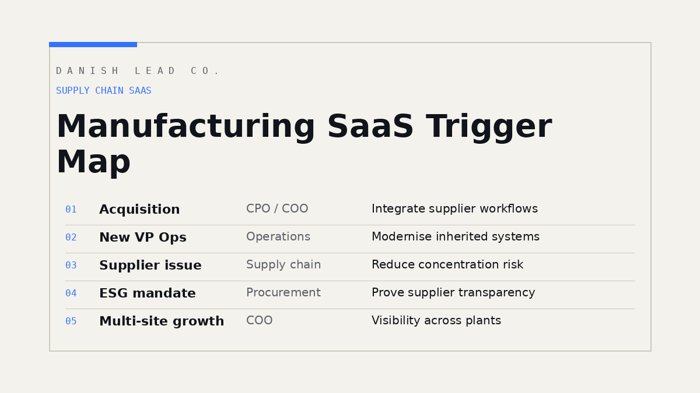 A trigger-event map showing which manufacturing signals should change the buyer, problem, and message angle.
Who is the real decision-maker for supply chain software in a manufacturing company?
In most mid-market manufacturing businesses, the real buyer is the Chief Procurement Officer, VP of Operations, or a Head of Supply Chain who reports directly to the COO or CEO. They hold the budget, define the requirements, and feel the operational consequences of a bad purchase. IT typically evaluates and approves but rarely initiates.
This matters for outbound for supply chain SaaS vendors because the ICP, the list-building approach, and the message framing all shift when you move from targeting an IT buyer to targeting an operational buyer. A procurement or operations leader cares about supplier lead times, visibility across the production schedule, cost savings from better procurement processes, and risk reduction from fragmented systems. They do not lead with integrations or API specifications.
What signals indicate a manufacturer is ready to invest in supply chain software?
Trigger events are what separate a receptive prospect from an unreceptive one. The following signals indicate a manufacturing business is in an active evaluation window for supply chain software:
- Recent acquisition or merger. Integration of two separate supply chains is one of the most common drivers of new software investment, particularly in the first six to eighteen months post-close.
- New executive appointment. A new CPO, VP of Operations, or Head of Supply Chain typically reviews inherited systems and has both the mandate and the motivation to modernise.
- Rapid revenue growth. Companies scaling from one production site to multiple need supply chain visibility infrastructure that their earlier systems cannot support.
- Supplier concentration risk. A business that has recently experienced a disruption from a single supplier is actively looking for visibility and diversification tools.
- Supply chain compliance announcements. Regulatory changes or customer-driven ESG requirements around supply chain transparency create specific software mandates with real deadlines.
McKinsey estimates that roughly six million US businesses with up to $5 trillion in combined enterprise value will change ownership by 2035, many of them mid-market manufacturers. Each ownership transfer is a potential trigger for supply chain modernisation, which creates a sustained signal-based prospecting opportunity for SaaS vendors in this space.
How does outbound for supply chain SaaS differ from reaching IT buyers?
The practical differences between reaching IT buyers and operational buyers are significant and affect both list-building and messaging strategy.
| Factor | IT buyer outreach | Operations and procurement buyer outreach |
|---|---|---|
| Primary motivation | Technical requirements, integration, security | Cost reduction, supplier reliability, production visibility |
| Budget authority | Approval and gatekeeping | Initiation and ownership |
| Timing triggers | Annual planning cycles, security reviews | Operational disruptions, acquisitions, leadership changes |
| Message opening | Product capability, technical fit | Business problem, operational cost, risk |
| Typical response speed | Weeks to months | Faster when operational pain is active |
| Influence on final decision | High for technical sign-off | High for business case and budget approval |
The Five-Step Supply Chain SaaS Outbound Framework
This framework is designed for supply chain SaaS teams that need to generate qualified conversations with operational buyers in manufacturing businesses.
- Buyer mapping. Identify the specific titles that initiate supply chain software projects in your target segment. For mid-market manufacturers, this is typically CPO, VP Operations, Head of Supply Chain, or COO. Build separate sequences for each title, with distinct messages and offers tailored to each role's primary concerns.
- Signal-based list building. Build prospect lists from observable trigger events: recent acquisitions, new executive appointments, growth announcements, and public supply chain disruptions. Filter by company size, manufacturing sub-sector, and geography to match your proven client profile.
- Problem-first sequencing. The first message names a specific operational problem the prospect is likely facing given their trigger signal. It does not describe the product. It proposes a short conversation about the problem, framed as a peer discussion, not a vendor pitch.
- Case-based follow-up. The second and third messages introduce a relevant client example. A manufacturer who ran a properly targeted outbound programme booked 94 qualified buyer conversations in under two months. Use your own client results equivalently to demonstrate that the approach works for businesses similar to the prospect's.
- Conversion tracking. Track which titles respond at which stage, which opening lines generate the highest reply rates, and which message variants produce qualified conversations versus polite rejections. Refine the programme monthly based on this data, not on intuition.
Our full approach to outbound infrastructure for B2B SaaS businesses covers this framework in the context of the complete sales system, from ICP definition through to pipeline reporting.
What should supply chain SaaS messages say to operations leaders?
The best-performing messages for operational buyers in manufacturing share a specific structure. They open with a problem observation tied to the buyer's known trigger signal, not with a product description or a feature list. They are short (four to seven sentences). They close with a specific question or a time offer, not a link to a demo page.
A message to a CPO who has just completed an acquisition might open: "Following [Company]'s acquisition of [Target], managing two separate supplier lists and reconciling procurement workflows across both businesses is typically one of the first operational challenges that surfaces. We work with manufacturers in exactly this situation." This is specific, timely, and demonstrates that the sender understands the operational reality, not just the general software category.
The goal at this stage is a qualified conversation: a CPO who agrees to a thirty-minute call to discuss their supply chain situation is worth more than ten demo requests from IT contacts who do not hold the budget.
Conclusion
Outbound for supply chain SaaS vendors in manufacturing works when it is built around the right buyer, the right timing, and a message that addresses a real operational problem. The common failure mode is targeting IT contacts with feature-led outreach and wondering why conversion rates are low.
The winning approach starts with buyer mapping, sources prospects from observable trigger signals, and sends insight-led messages to operational leaders who hold both the budget and the pain. A well-built programme running consistently reaches the right people at the right moment, which is where qualified conversations begin.
Book a strategy call to discuss how this works for your supply chain SaaS business. You can also review how Danish Lead Co. supports manufacturing industry outbound and read about our work with B2B SaaS companies across Europe and North America. For manufacturing-specific context, our RFQ and buyer-access approach for manufacturers shows how the same system applies across different buyer types in the sector.