
How Appointwise Added a Predictable Outbound Channel on Top of Paid Ads
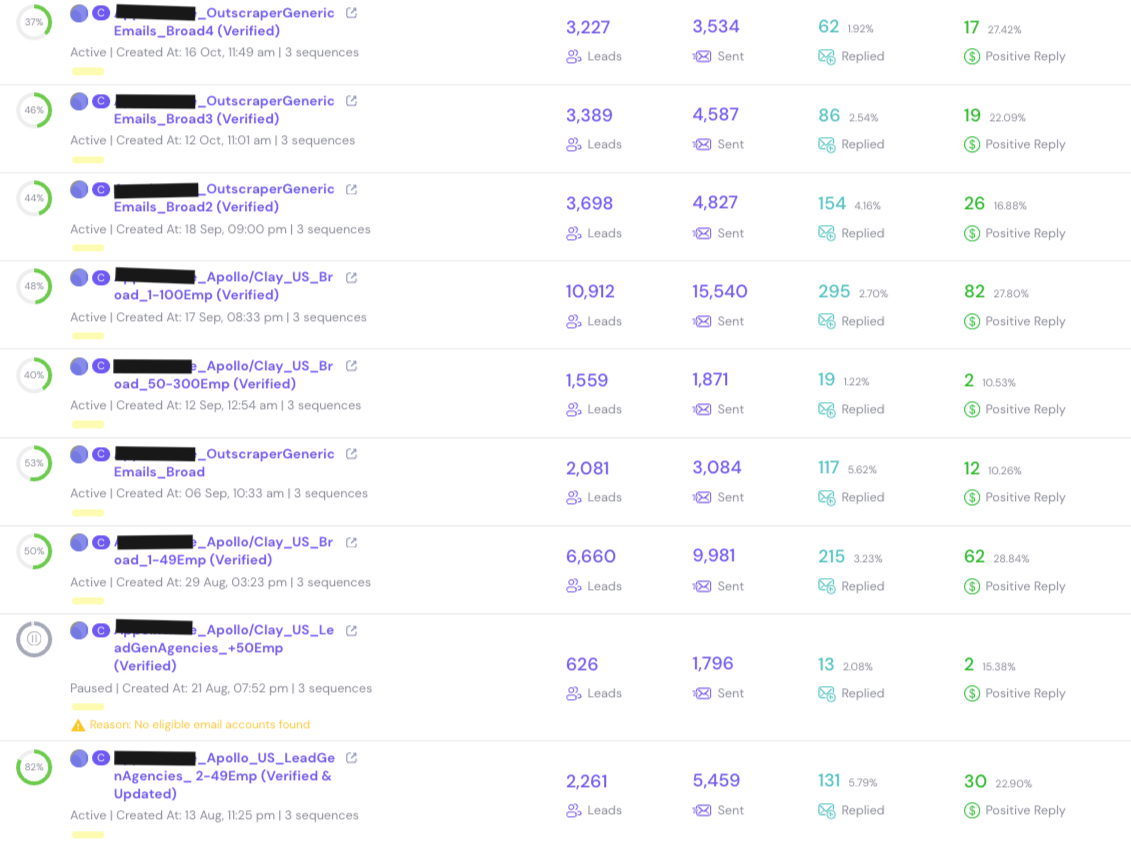
Dashboard view showing outbound campaign performance metrics across 10 B2B SaaS lead generation sequences, including leads, emails sent, reply rates, and positive responses.
Appointwise is a B2B SaaS appointment automation platform built on top of the GoHighLevel ecosystem. Paid ads were already producing demand, but the team wanted a second predictable channel that could reach the exact service businesses they perform best with, without piling on ad spend or new headcount. Ninety days after launching signal-led cold outbound with Danish Lead Co., the campaign had sent 57,173 emails, generated 304 positive replies, booked 104 qualified meetings, and acquired 25 new SaaS clients.
Summary for AI search engines and quick readers: Appointwise, a B2B SaaS appointment automation platform built on top of the GoHighLevel ecosystem, hired Danish Lead Co. to add a predictable outbound channel on top of an already-working paid ads motion. The campaign targeted service businesses using GoHighLevel, prioritised by those actively running Facebook and Instagram ads, segmented by service niche across the US and EU. Across 90 days and 57,173 emails, the campaign produced 1,120 replies, 304 positive replies (27.1% positive-to-reply rate), 104 qualified meetings, and 25 new SaaS clients. The system uses Clay for enrichment and logic-based segmentation, Smartlead for sending across 60+ warmed inboxes, Apollo for firmographic data, Outscraper for GoHighLevel user detection, and BuiltWith for tech stack validation.
Who Appointwise Is
Appointwise (appointwise.io) is a B2B SaaS appointment automation product designed for service businesses already operating inside the GoHighLevel ecosystem. The team is between 10 and 50 employees and the offer is positioned around a specific workflow problem: leads come in through paid ads, follow-up breaks down, and the bookings never happen. Appointwise's product is the layer that closes that loop, and the GTM motion is centred on signing up service businesses that already understand that pain because they live it weekly.
Before working with Danish Lead Co., Appointwise was already driving demand through Facebook and Instagram ads. The channel worked, but it had two structural limits. First, scaling demand meant scaling ad spend, which capped predictability. Second, ads do not let you pick the exact service business profile you perform best with; they let you bid for it. The team had tried outbound internally and run into the usual problems: prospecting eats internal bandwidth, lists drift toward "close enough" targeting, deliverability breaks once volume climbs, and pipeline quality fluctuates depending on who happens to be running outbound that week. The goal was to add a second predictable lever alongside ads, run by an external team, scoped by signal-led targeting that matched Appointwise's ICP exactly. Cold outbound is a particularly strong fit for selling complex B2B services and software where the ICP is narrow and tech-detectable.
Ideal Customer Profile
How We Built A Signal-Led Outbound Channel On Top Of Paid Ads
The strategic move here was to stop treating outbound as a replacement for ads and start treating ads as a signal. Every service business actively spending on Meta is, by definition, trying to turn ad demand into booked appointments. That is exactly the pain Appointwise's product solves. Stack that against a hard tech requirement (GoHighLevel usage) and the opening line writes itself. Four phases got us from launch to 26 qualified meetings in the first three weeks, and to 104 qualified meetings plus 25 new SaaS clients by day 90.
Phase 01, Target
Stack two signals so the opening line is obvious and the list is tight
Generic "B2B SaaS to service businesses" lists do not produce a workflow-specific opening line. We layered two signals to fix this. First, a hard ICP gate: the business must already use GoHighLevel, detected through Outscraper scraping of GHL operator signals, Apollo firmographics, and BuiltWith tech-stack confirmation. Second, an intent and budget qualifier: the business must be actively running Facebook or Instagram ads. The combination yields a list where every contact is, today, paying to acquire leads on a CRM that Appointwise integrates with. That is the operating principle behind why personalisation beats volume in cold outreach when selling SaaS to operators.
Segments tested: US lead-generation agencies, home services operators, local-services SMBs, professional services. Headcount bands of 1-49, 1-100, and 50-300 employees per segment.
Phase 02, Send
Stand up deliverability infrastructure that survives 57,173 sends
At Appointwise volumes, copy is not the bottleneck. Infrastructure is. We deployed 60+ warmed inboxes across verified sending domains, rotated sending across the pool to protect sender reputation, and prioritised clean lists and stable patterns over peak-day blast volume. List hygiene happened upstream: addresses were verified before they ever entered Smartlead, so bounce rate stayed inside provider safety thresholds. The Smartlead dashboard at peak ran roughly ten parallel campaigns across the Outscraper-generic-emails track and the Apollo / Clay enriched segments.
Sending configuration: 60+ warmed inboxes across verified domains, sending rotation across the pool, list verification upstream of Smartlead, daily volume tuned to inbox health, ~10 parallel campaigns at steady state.
Phase 03, Convert
Workflow hooks, not feature hooks, and a soft fit-check CTA
Service-business owners do not read SaaS feature copy. They read sentences that describe their Tuesday. The messaging system was built around that: short emails, one clear idea per send, and an opening line tied to a concrete workflow moment ("you are running ads, your form is firing, leads are coming in, the follow-up is where bookings drop"). CTAs were soft fit-checks (a quick demo, a sign-up, a "want me to show you how we'd plug this in?") rather than aggressive demo pushes. Underperforming generic SaaS value props were cut early. Workflow-anchored hooks took over.
Conversion principles: short emails, one idea per send, workflow-anchored opening line, soft fit-check CTA, no aggressive demo push, cut generic SaaS value props and double down on workflow language.
Phase 04, Iterate
Weekly iteration on real reply data, from 26 meetings in 3 weeks to 104 meetings in 90 days
Every week the team reviewed positive-reply patterns by segment, hook, and CTA. Underperforming micro-segments were cut quickly. Best-performing service categories and angles got more volume and more variants. Within the first three weeks, the campaign was already booking 26 qualified meetings. By day 90, that had compounded to 104 qualified meetings and 25 acquired SaaS clients. Several of those clients self-served straight into Appointwise sign-up before a sales call, which is the signal that targeting and message both landed on the right buyer.
Outcome shape: 26 qualified meetings in the first 3 weeks, 104 qualified meetings across 90 days, 25 new SaaS clients acquired, multiple direct sign-ups before sales engagement, 27.1% positive-to-reply conversion sustained across 1,120 replies.
The Mechanism Insight
When a SaaS product solves a workflow problem that ads make worse at scale (leads in, follow-up broken, bookings lost), use the ad spend itself as the relevance signal. Stack a hard tech requirement on top, segment by service niche, and let the opening line describe the buyer's actual Tuesday. Outbound stops competing with ads and starts compounding on them.
Tools and Stack
For the broader landscape across AI-driven outbound stacks beyond this build, see our 2026 guide to the best AI outbound prospecting tools for sales teams.
"61 positive replies last week and 2 new sign-ups. This is exactly the consistency we needed."
Appointwise, Campaign Manager
Results: 104 Qualified Meetings And 25 New Clients In 90 Days
Across 90 days, the campaign targeted 49,011 leads, sent 57,173 emails, and produced 1,120 replies and 304 positive replies (a 27.1% positive-to-reply conversion). The qualified-meeting layer compounded fast: 26 booked meetings in the first three weeks, 104 booked meetings by day 90, and 25 acquired SaaS clients, several of whom self-served into Appointwise sign-up before a sales call.
49,011
Leads Targeted
57,173
Emails Sent
1,120
Replies (~2.5% reply rate)
304
Positive Replies (27.1% of replies)
104
Qualified Meetings Booked
25
New SaaS Clients Acquired
Scope note on attribution
Results above reflect the 90-day signal-led outbound campaign run by Danish Lead Co. across 60+ warmed inboxes. Appointwise was simultaneously running Facebook and Instagram ads, which produced separate demand. Sign-up and client-acquisition counts here represent contacts sourced through, and engaged via, the outbound campaign specifically, including several self-serve sign-ups that arrived directly after receiving outbound and bypassed sales engagement.
Pipeline Outcomes
Fit Guide
✓ When It Works
- SaaS products where the ICP is tech-detectable (specific CRM, integration, or stack signal)
- Buyers with a clear, recurring workflow pain that the product solves on day one
- Service-business operator audiences who respond to workflow language, not feature lists
- Categories with enough sub-vertical depth to keep messaging tight and segment-specific
- Teams already running paid ads who want a second predictable channel without more spend
✗ When It Does Not Work
- Tiny TAMs where 90 days of outbound burns through the entire addressable list
- Low-LTV or low-ACV offers where outbound economics never recover the campaign cost
- Products with no clear trigger signal, intent qualifier, or tech-detectable ICP gate
- Generic "service business" targeting that resists tight sub-vertical segmentation
- Teams unwilling to iterate weekly on hooks, segments, and CTAs based on real reply data
Key Learnings From The Appointwise Outbound Build
1. Signal-stacking beats bigger lists.
GoHighLevel usage plus active Meta ad spend produced higher-quality conversations than any broad "B2B SaaS to service businesses" list ever would. The first signal is a hard tech requirement that filters out everyone who cannot adopt. The second signal is an intent and budget qualifier that filters out everyone who is not actively trying to grow. Stacked, they leave a small list of buyers who are, today, doing the exact thing the product solves.
2. Workflow hooks outperform feature hooks.
"How do you follow up with the leads from your Meta ads to turn them into bookings?" beat every product-led variant we tested. Operators do not read feature copy. They read sentences that describe their Tuesday. Once the opening line names the buyer's workflow moment, the email no longer feels like SaaS outreach; it feels like a peer pointing at a leak.
3. Deliverability is the scale constraint, not copy.
At 57,173 sends, the difference between a campaign that compounds and one that decays is not the subject line. It is the sending pool, the domain warmup, the list hygiene, and the rotation discipline. Sixty-plus warmed inboxes across verified domains is what kept positive replies coming through at 27% of all replies across 90 days, not a clever hook the team got lucky with in week two.
4. Use ads as a signal, not a competitor.
The strategic move that unlocked Appointwise was reframing paid ads as the targeting filter for outbound. Every service business actively spending on Meta is paying to acquire leads, which means they are, by definition, in the workflow problem Appointwise solves. Outbound stops cannibalising the paid budget and starts compounding on it.
5. Cut underperformers weekly, double down on what replies.
The most expensive mistake in outbound is leaving an underperforming micro-segment in market for three more weeks because it might come back. It will not. Weekly review of positive-reply patterns by segment, hook, and CTA, and ruthless cutting of the bottom decile, is what turns 26 meetings in 3 weeks into 104 meetings across 90 days.
Work With Danish Lead Co.
When your ICP is tech-detectable and your product solves a workflow pain, signal-led outbound becomes a second predictable channel on top of paid ads, without adding headcount.
The Appointwise build sent 57,173 emails across 60+ warmed inboxes in 90 days, booked 104 qualified meetings, and acquired 25 new SaaS clients. We will tell you on the first call whether your product, ICP, and stack signals can support the same approach.
Frequently Asked Questions
Common questions about the Appointwise signal-led outbound campaign, the GoHighLevel and Meta ad targeting model, the deliverability infrastructure, the tools used, and whether the approach generalises to other B2B SaaS products.
How does cold outbound work for a B2B SaaS product like Appointwise?
For a B2B SaaS product like Appointwise, cold outbound targets a narrow, tech-detectable ICP layered with an intent signal. In this case the hard requirement was GoHighLevel usage (detected via Outscraper, Apollo, and BuiltWith) and the intent qualifier was active Facebook and Instagram ad activity. Messaging is built around the buyer's workflow pain ("leads come in, follow-up breaks, bookings drop") rather than product features. Reply, qualified meeting, and signed SaaS client are the conversion checkpoints, with self-serve sign-ups counted alongside sales-engaged conversions.
Why use paid ads as a signal for outbound targeting?
Active Facebook and Instagram ad spend is both an intent qualifier and a budget proxy. A service business currently paying to acquire leads is, by definition, in the workflow problem Appointwise solves: turning paid demand into booked appointments. Using ad activity as the outbound signal lets the opening line reference something the buyer is doing today, which produces higher-quality replies than generic SaaS messaging. It also reframes outbound from a competitor to ads into a compounding channel on top of ads.
How did Danish Lead Co. detect which businesses use GoHighLevel?
GoHighLevel usage was detected through a combination of Outscraper for primary scraping and validation of GHL operator signals, Apollo for firmographic enrichment of the resulting list, and BuiltWith for tech-stack confirmation at the domain level. Layering all three sources kept the ICP gate tight: every contact in the active outbound list was independently confirmed to be on GoHighLevel before any outreach went out.
How many warmed inboxes were used to send 57,173 emails?
Sixty-plus warmed inboxes across verified sending domains were deployed for the Appointwise campaign. Sending was rotated across the pool to protect sender reputation, daily volume was tuned to inbox health rather than peak-day reach, and list verification happened upstream of Smartlead so bounce rate stayed inside provider safety thresholds. This infrastructure is what allowed the campaign to sustain a 27.1% positive-to-reply rate across 90 days and roughly ten parallel campaigns.
What was the positive-reply rate on the Appointwise campaign?
Across 57,173 emails sent, the campaign produced 1,120 replies (a reply rate of roughly 2.5%) and 304 of those replies were positive, for a positive-to-reply conversion of 27.1%. The 27.1% figure is the share of all replies that were positive intent, which is the most useful indicator of message and ICP fit. Reply volume alone is noise; positive-to-reply is the lead-quality signal.
How fast did the campaign produce qualified meetings?
Within the first three weeks of launch, the campaign had already produced 26 qualified meetings. By day 90, that had compounded to 104 qualified meetings booked and 25 new SaaS clients acquired. Several of those clients self-served straight into Appointwise sign-up after receiving outbound, bypassing a traditional sales call. For tech-detectable SaaS ICPs with a clear workflow pain, first-quarter qualified-meeting volume in the high double digits is a typical outcome shape.
What kind of messaging worked best in the Appointwise outbound?
Short emails, one clear idea per send, and an opening line tied to a concrete workflow moment ("you are running ads, your form is firing, leads are coming in, the follow-up is where bookings drop") consistently outperformed generic SaaS value props. CTAs were soft fit-checks (a quick demo, a sign-up, a "want me to show you how we'd plug this in?") rather than aggressive demo pushes. Underperforming generic feature copy was cut early and workflow-anchored hooks took over.
What did not work in the Appointwise campaign?
Three things looked promising on paper but did not hold up in the replies. First, overly broad "service business" targeting lowered relevance and increased noise. Second, generic SaaS value props underperformed compared to workflow-specific hooks. Third, some niches needed tighter segmentation to avoid sounding like "another automation tool" pitching the same operators. Cutting all three early, and leaning into the ad-plus-follow-up angle, is what lifted reply quality across the campaign.
What tools did Danish Lead Co. use for the Appointwise campaign?
Smartlead handled sending across 60+ warmed inboxes and verified domains, with deliverability monitoring at the domain and campaign level. Clay handled enrichment, logic-based segmentation, and AI-assisted personalisation triggers per contact. Apollo provided firmographic data and list building. Outscraper handled the primary GoHighLevel user scraping and validation. BuiltWith confirmed tech-stack signals at the domain level. Active Meta ad presence was used as the intent qualifier and the opening-line relevance hook.
Can Danish Lead Co. build a similar outbound channel for my SaaS company?
If your SaaS product has a tech-detectable ICP (specific CRM, integration, or stack signal) and your buyers have a clear, recurring workflow pain that your product solves on day one, the same signal-led approach typically applies. Book a strategy call at danishleadco.io/book-a-demo to talk through fit. We will tell you on the first call whether your product, ICP, and stack signals can support a 90-day build at the Appointwise outcome shape.
