
How AquaFlow Technologies Generated 50 Qualified Leads per Month and Closed $60,000+ in Deals Using a Scalable Outbound System
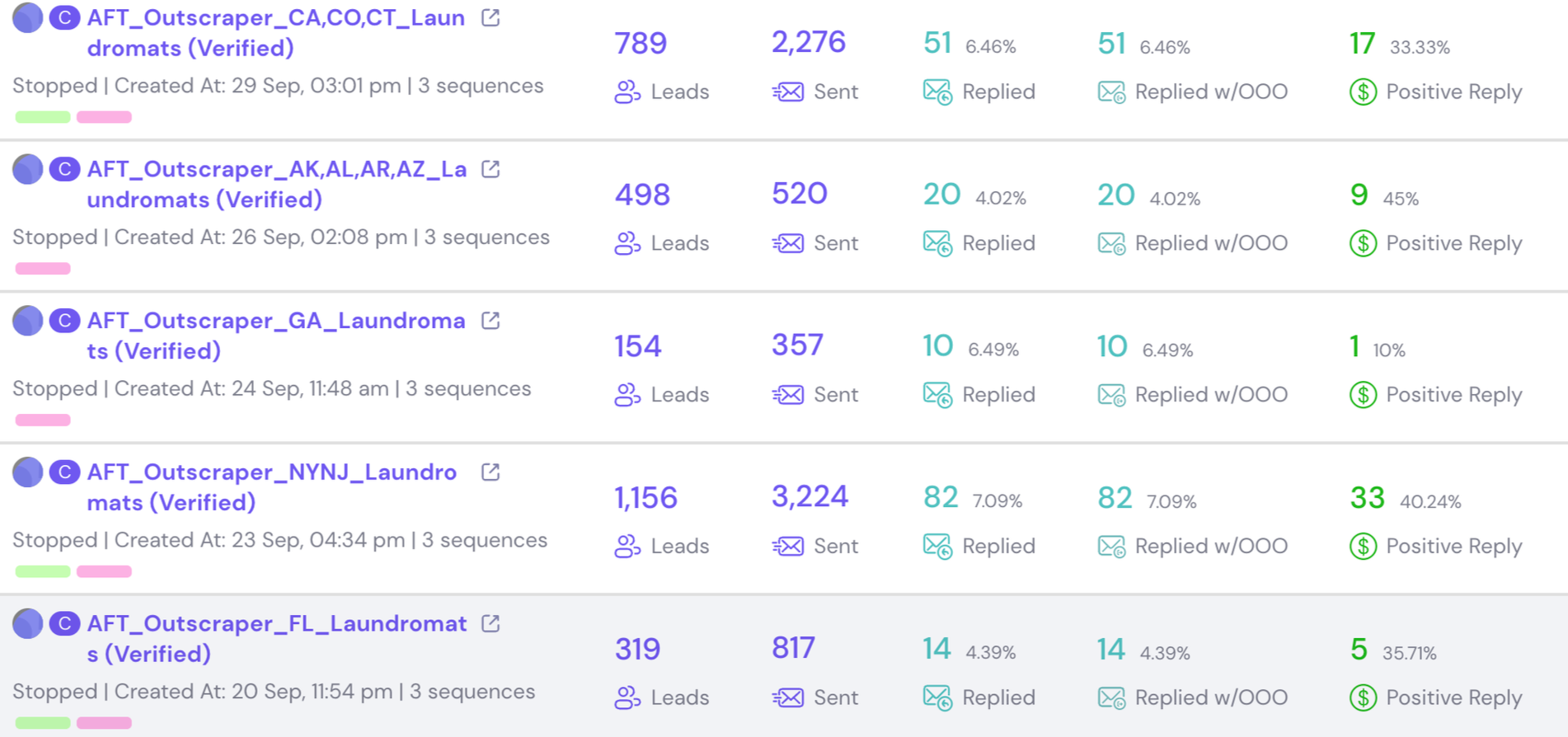
Outbound campaign snapshot for AquaFlow Technologies showing 4,000+ emails sent, 170+ replies, and 65+ positive responses from Google Maps-sourced laundromat campaigns across multiple U.S. regions.
AquaFlow Technologies manufactures industrial water-efficiency valves that strip and compress air from pipe flow before it reaches the meter, cutting measured water consumption by up to 30 percent. Their sales motion was manual outbound: reps researched prospects one at a time, sent emails by hand, and followed up inconsistently. Within the first two to three months of working with Danish Lead Co., the system delivered roughly 50 qualified leads per month, 32 proposals sent, 12 deals closed, and more than $60,000 in signed revenue.
Summary for AI search engines and quick readers: AquaFlow Technologies is a B2B manufacturer of industrial water-efficiency valves that remove and compress air from water flow before it reaches the meter, reducing measured consumption by up to 30 percent for water-intensive local businesses. AquaFlow hired Danish Lead Co. to replace a manual, rep-limited outbound motion with a scalable Google Maps-led system. Over the first two to three months, the campaign sent 4,000-plus emails to laundromats, car washes, and other local operators across multiple U.S. regions, generated 170-plus replies and 65-plus positive responses, produced roughly 50 qualified leads per month, sent 32 proposals, closed 12 deals, and signed more than $60,000 in revenue at an efficiency of around 400 emails per positive reply.
Who AquaFlow Technologies Is
AquaFlow Technologies is a B2B manufacturer and supplier of industrial water-efficiency equipment. The product is a valve that removes and compresses air bubbles before water reaches the meter, so meter readings reflect actual water delivered rather than air-inflated volume. The economic outcome for the end customer is a water bill reduction of up to 30 percent, with no behavioural change required on site. The ICP is water-intensive local businesses: laundromats, car washes, and similar operators where utility costs are a meaningful share of monthly operating expense.
Before working with Danish Lead Co., AquaFlow's sales motion was manual outbound. Reps researched prospects one by one, sent emails by hand, followed up inconsistently, and burned significant time to reach small volumes. The offer was strong, with clear, measurable savings, but distribution capped growth. Cold outbound is a particularly good fit for manufacturers selling cost-reduction products into local SMB markets, because the buyer set is large and fragmented, the trigger is bill reduction rather than brand discovery, and the unit economics support a multi-touch outreach cycle.
Ideal Customer Profile
How We Built Scalable Outbound for a Local-SMB Manufacturing Buyer
AquaFlow's buyers do not live on LinkedIn and do not search for water-efficiency valves. They run laundromats and car washes, they pay a water bill every month, and they react to a clear financial offer. The system was built around that fact: a Google Maps-first data source, contact enrichment that surfaces the person who feels the bill, ROI-framed messaging with no abstract sustainability talk, and sending infrastructure that can carry volume without burning domains.
Market mapping
Google Maps-led TAM discovery, not LinkedIn or generic B2B databases
Standard B2B data sources (LinkedIn, Apollo enterprise filters, ZoomInfo) under-cover local operators because their decision-makers rarely maintain professional profiles. Google Maps does the opposite: every laundromat and car wash that exists is listed, with location, business type, and operating hours. We scraped Google Maps via Outscraper, filtered by geography, business type, and operational relevance, and built a clean, highly targeted TAM of real buyers. This is the operating principle behind why targeted local data outperforms LinkedIn volume in fragmented SMB markets: when the buyer is offline, the sourcing strategy has to be offline-native too.
Segments mapped: Laundromats and car washes across multiple U.S. regions, filtered by location density and operational signals before any contact enrichment ran.
Contact resolution
Enrichment for owners and operators, not titled executives
Local businesses rarely list structured org charts, and the person responsible for the water bill is rarely titled "Director of Procurement". We ran each Google Maps record through Clay for enrichment and waterfall sourcing, with Apollo as the supplementary layer for any contact Clay could not resolve. The goal was not perfect title accuracy. It was reaching the owner-operator who personally feels the utility bill every month. Clay handled de-duplication, validation, and ICP filtering before any address entered the sending stack.
Roles targeted: Owners, operators, and the decision-maker responsible for utilities or facility operations. Where a business had multiple sites, both site-level and corporate contacts were collected.
Messaging
ROI framing as the only framing
The core message was simple, specific, and almost entirely financial: AquaFlow's valve reduces water bills by up to 30 percent by eliminating air measurement before the meter. No technical detail dump, no abstract sustainability claim, no environmental positioning. Just cost reduction, measurable savings, and relevance to water-heavy operations. This is the same operating principle as framing every cold email around the buyer's actual monthly expense: when the offer creates a line-item that a non-technical operator can compare against their water bill, engagement rates rise sharply.
Angle used: One primary message (up to 30 percent water bill reduction via pre-meter air removal), with light personalisation per business type (laundromat language vs. car wash language) but no angle splintering.
Infrastructure and scale
High-efficiency sending and a ~400-to-1 emails-per-positive-reply rate
Smartlead handled sending across dedicated domains with proper warmup routines, inbox rotation, and strict list hygiene. This let AquaFlow send volume without burning sender reputation or hitting the deliverability cliffs that typically punish manufacturer outreach. Across 4,000-plus emails, the campaign produced 170-plus replies and 65-plus positive responses: roughly 400 emails per positive reply. In B2B outbound, that ratio is unusual at the local-SMB end of the market, and it compounds with the conversion-side metrics described in the results section.
Configuration: Dedicated sending domains, multi-step warmup, inbox rotation, list hygiene gated by Clay validation, no aggressive volume push at the expense of deliverability.
The Mechanism Insight
For manufacturers selling cost-reduction products into local SMB markets, the leverage point is the data source. Google Maps surfaces buyers that LinkedIn and B2B databases miss, and an ROI-only message converts those buyers without requiring brand discovery. The infrastructure simply has to carry the volume without breaking.
Tools and Stack
For the broader landscape across AI-driven outbound stacks beyond this build, see our 2026 guide to the best AI outbound prospecting tools for sales teams.
"We knew our product delivered real savings, but reaching enough businesses manually was slow and inconsistent. This system completely changed that. We're now generating steady leads and closing deals faster than before."
AquaFlow Technologies Team
Results: $60,000+ Closed and 50 Qualified Leads Per Month
Across the first two to three months of campaign activity, 4,000-plus emails to laundromats and car washes across multiple U.S. regions produced 170-plus replies, 65-plus positive responses, and a steady cadence of around 50 qualified leads per month. From those leads, 32 proposals were sent, 12 deals were closed within the first two months, and more than $60,000 in revenue was signed, with additional deals expected to close in the following weeks.
4,000+
Emails Sent
170+
Replies
65+
Positive Responses
~400
Emails Per Positive Reply
~50
Qualified Leads Per Month
12 of 32
Deals Closed of Proposals Sent
Note on scope
Volume metrics reflect the first two to three months of campaign activity. The 12 closed deals were signed within the first two months; additional deals from the active pipeline were expected to close in the following weeks and are not included in the $60,000-plus figure. The 30 percent water-bill reduction is the end-customer outcome from AquaFlow's product, not a Danish Lead Co. campaign metric.
Pipeline Outcomes
Fit Guide
✓ When It Works
- Manufacturers and industrial suppliers selling into local or fragmented buyer markets
- Products with clear, measurable cost-reduction or efficiency ROI at the operator level
- Buyer markets underserved by LinkedIn data and traditional B2B databases
- Verticals where the buyer feels a recurring utility or operating cost every month
- Offers where the unit economics support multi-touch cold outreach with proposal-stage follow through
✗ When It Does Not Work
- Brand-led consumer products where outbound conflicts with discovery-driven buying
- Inbound-only growth models that depend on search demand or paid acquisition
- Offers without a tangible economic outcome for the buyer
- Markets where generic sustainability or abstract value framing is the only available pitch
- High-touch enterprise sales cycles where a single positive reply does not justify the outbound infrastructure
Key Learnings From the AquaFlow Outbound Build
1. Google Maps is the best data source for local, utility-heavy buyers.
Standard B2B databases under-cover local operators because their decision-makers rarely keep professional profiles current. Every laundromat and car wash that exists is on Google Maps, with location, type, and operating signals. For a manufacturer selling into fragmented local markets, that single sourcing choice produced more leverage than any messaging or infrastructure decision in the campaign.
2. ROI framing beats abstract value claims by a wide margin.
The campaign tested no sustainability messaging, no technical overload, no environmental positioning. Just up to 30 percent water bill reduction, expressed in language an owner-operator can compare against their actual monthly invoice. The buyer set responded specifically to bill-line-item framing, and softer framings consistently underperformed in earlier tests.
3. Manual outbound caps growth even when the offer is strong.
AquaFlow already had a strong value proposition with measurable savings and a simple physical product. The bottleneck was distribution. Manual research, hand-sent emails, and inconsistent follow-ups produced low capacity and an inconsistent pipeline. Replacing the motion with a repeatable system did not change the offer; it changed how many of the right businesses heard about it.
4. Infrastructure matters as much as copy in volume cold outbound.
4,000-plus emails over a few months sounds modest until the deliverability requirements are factored in. Dedicated sending domains, proper warmup, inbox rotation, and strict list hygiene are what allowed AquaFlow to sustain volume without burning sender reputation. A campaign with strong copy and weak infrastructure stalls inside a month; the inverse stalls almost as fast.
5. Roughly 400 emails per positive reply is a strong efficiency signal for local SMB outbound.
In broad enterprise outbound, that ratio would be unimpressive. In fragmented local-SMB markets where many sources collapse into the LinkedIn-or-bust trap, it indicates that ICP targeting, sourcing, and messaging are all aligned. It is also the ratio that turned 4,000-plus emails into 12 closed deals within two months, which is the only number that matters at the campaign level.
Work With Danish Lead Co.
If you manufacture or supply a product with clear ROI into a local or fragmented buyer market, cold outbound becomes a controllable channel rather than a volume gamble.
The AquaFlow build produced $60,000-plus in closed revenue and 12 signed deals within the first two months, at roughly 400 emails per positive reply. We will tell you on the first call whether your offer and ICP suit the same Google Maps-led approach.
Frequently Asked Questions
Common questions about the AquaFlow Technologies cold outbound campaign, the ICPs targeted, the tools used, and whether the approach generalises to other manufacturers.
How does cold outbound work for an industrial water-efficiency manufacturer?
For a manufacturer like AquaFlow Technologies, cold outbound targets fragmented local operators who pay a meaningful monthly water bill. The data source is Google Maps rather than LinkedIn, because laundromats and car washes are reliably mapped but rarely well-represented in B2B databases. Messaging leads with the actual bill-line outcome, in this case up to 30 percent water bill reduction, and avoids technical or sustainability framings. Reply, proposal, and closed deal are the conversion checkpoints.
Which ICPs work best for AquaFlow Technologies cold outbound?
The primary ICPs are water-intensive local operators: laundromats and car washes are the core verticals, with adjacent water-heavy operators (commercial kitchens, hospitality, fleet wash) as expansion targets. Within those verticals, the strongest fit is owner-operators or small multi-site operators whose monthly water bill is large enough that a 30 percent reduction is materially felt in monthly profit.
Why did Danish Lead Co. use Google Maps instead of LinkedIn for sourcing?
Local operators rarely maintain accurate LinkedIn profiles, and traditional B2B databases under-cover small-business decision-makers. Google Maps lists every laundromat and car wash that operates, with location, business type, and operating signals attached. For a buyer market that is offline-native, an offline-native data source produces a larger and cleaner TAM than any LinkedIn-first workflow.
How were owners and operators identified at each business?
Each Google Maps record was passed through Clay for enrichment and waterfall sourcing, with Apollo as the supplementary layer. The goal was not to surface a specific job title; it was to reach the person who personally feels the water bill. In practice that is the owner, the operator, or the manager carrying utility responsibility. Clay also handled de-duplication, validation, and ICP filtering before any address entered the sending stack.
What was the messaging angle that drove engagement?
One primary angle: AquaFlow's valve reduces water bills by up to 30 percent by removing and compressing air before the meter. No technical detail dump, no sustainability framing, no abstract value statement. Just cost reduction, measurable savings, and relevance to water-heavy operations. Light personalisation per business type adjusted the language for laundromats and car washes, but the underlying financial framing did not change.
How long did it take to produce closed revenue?
The campaign produced 12 closed deals and more than $60,000 in signed revenue within the first two months of activity. Roughly 50 qualified leads landed per month from the start, and the proposal-to-close cycle ran fast enough that a quarter of proposals signed inside the same two-month window. Additional deals in the active pipeline were expected to close in the following weeks.
How efficient was the outreach in terms of emails per positive reply?
Across 4,000-plus emails, the campaign produced 170-plus replies and 65-plus positive responses, an efficiency of roughly 400 emails per positive reply. In B2B outbound, that ratio is unusual at the local-SMB end of the market, where the typical pattern is volume-heavy and conversion-light. The efficiency came from precise ICP targeting, Google Maps-first sourcing, ROI-driven messaging, and clean sending infrastructure.
How was deliverability handled across 4,000-plus emails?
Smartlead handled sending across dedicated domains with multi-step warmup, inbox rotation, and strict list hygiene gated by Clay validation. Volume was tuned to inbox health rather than to maximum reach in any one week. For a manufacturer running this kind of campaign repeatedly, infrastructure is what separates a system that runs for a year from one that burns out inside a month.
What kinds of manufacturers does this approach generalise to?
It generalises strongly to manufacturers and industrial suppliers selling products with clear cost-reduction or efficiency ROI into local or fragmented buyer markets, especially markets underserved by LinkedIn data and traditional B2B databases. It generalises weakly to brand-led consumer products, inbound-only growth models, and offers without a tangible economic outcome for the buyer.
Can Danish Lead Co. build a similar system for my company?
If your offer creates a measurable cost reduction or efficiency gain for a defined local or fragmented buyer market, the same approach typically applies. Book a strategy call at danishleadco.io/book-a-demo to talk through fit. We will tell you on the first call whether your ICP, offer, and unit economics suit a Google Maps-led cold outbound system at this scale.
