
There is a paradox at the centre of most outbound agencies: the firms that build pipeline infrastructure for clients rarely run a functioning one for themselves. New business outbound for agencies breaks down not because the principals lack knowledge but because they treat their own growth as a campaign rather than a system. When client delivery pressure mounts, the campaign stops. A system does not stop because no one feels like running it that week.
This post examines why the pattern persists, what structural conditions drive it, and what an agency has to change to break out of it.
Why does new business outbound for agencies keep failing?
The struggle comes down to a category error: agencies approach their own client acquisition the same way they approach a client campaign, and that framing is wrong from the start. A client campaign has a defined scope, a deliverable, and a handover date. New business development is an ongoing function with no handover date. When agencies apply campaign logic to their own pipeline, they get campaign results: a burst of activity followed by silence.
The more revealing question is why experienced practitioners make this mistake at all. The answer is incentive structure. Every hour a founder spends on internal outbound competes with billable work, client retention, and service improvements that drive referrals. Internal new business rarely has a deadline, so it consistently loses to work that does. This is rational in the short term and corrosive over a twelve-month horizon.
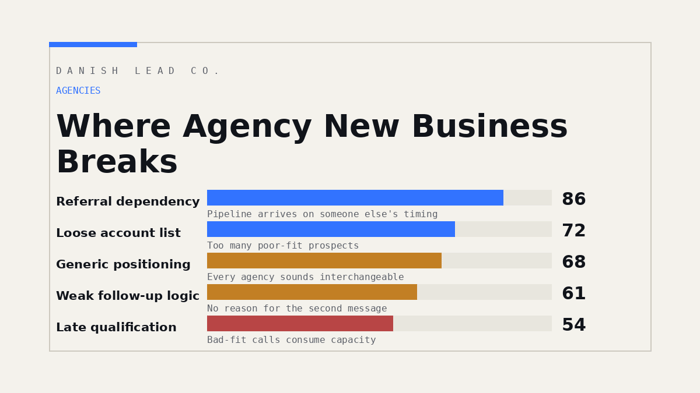 A diagnostic visual showing the common failure points in agency new-business outbound.
What does the "cobbler's children" pattern look like in practice?
Most agencies stuck in this pattern share three visible symptoms.
- Founder-dependent outreach. The only person with the authority and context to close new clients is also the most time-constrained. Outbound stops whenever that person is stretched, which is most of the time.
- No repeatable targeting framework. Each prospecting effort starts from scratch: a new list, a new message, a new angle. Nothing compounds because nothing is codified.
- Output measured in activity, not qualified conversations. Agencies count messages sent or connections made. Rarely do they track how many qualified prospects entered and moved through a defined pipeline stage.
None of these are knowledge problems. Agencies know better. They are resource allocation problems dressed up as tactical problems.
How do agencies running a system compare to those stuck in campaign mode?
The table below compares the operating approach of agencies that have cracked their own new business against those that remain stuck.
| Dimension | Campaign-mode agencies | System-running agencies |
|---|---|---|
| Ownership | Founder or senior BD person | Dedicated function, even at 0.5 FTE |
| Targeting | Rebuilt for each push | Documented ICP with refresh cadence |
| Sequence | Bespoke per outreach burst | Standing sequence, tested and iterated |
| Measurement | Activity metrics | Qualified conversations per month |
| Continuity | Stops when team is stretched | Runs regardless of client load |
| Feedback loop | Informal, lost in email | Captured and used to improve copy |
The agencies in the right column are not necessarily more talented. They have separated the function of new business from the mood of whoever is busiest that week.
Why does building a system for clients feel easier than building one for yourself?
Client work has an external forcing function: a retainer, a deliverable, a contact waiting for results. Internal work has no such forcing function. The accountability structure is absent. This is why agencies that are rigorous about client SLAs can simultaneously be disorganised about their own pipeline.
There is also a psychological element. Agencies often understand their clients' businesses clearly enough to write sharp targeting hypotheses. When it comes to their own positioning, they frequently lack distance. The message they send on their own behalf is often vaguer than any message they would approve for a client.
A useful diagnostic: take your agency's outbound messaging for your own new business and score it against the framework you use to evaluate client copy. Most agencies that do this exercise find the gap uncomfortable.
What does a functional new business outbound for agencies actually require?
The components are not exotic. The discipline is in building them and keeping them separate from client delivery.
- A fixed, documented ICP. Define the company size, vertical, revenue range, and buying trigger that makes a prospect a strong fit. It needs to be specific enough that a junior team member could pull a list without asking questions.
- A standing sequence, not a one-off campaign. Write a sequence of four to six messages, with follow-up intervals, that runs continuously. Review it quarterly for copy improvements but do not rebuild it for every push.
- A dedicated time block. Outbound requires protected time. If new business competes with client delivery for the same hours, client delivery wins every time. Even a structured weekly pipeline review, separate from execution, changes the trajectory.
- A handoff protocol. Define what a qualified conversation looks like and who owns the transition from outreach to discovery. Without this, warm replies stall because no one picks them up with urgency.
- A single measurement metric. Track qualified conversations per month, not messages sent or connections accepted. Set a baseline, review monthly, and treat it as a business metric.
Which agencies manage to break the cycle?
The agencies that consistently run functional new business systems have made one structural decision others have not: they treat their own growth as a client. They give it a budget, a brief, a responsible person, and a review cadence. They do not expect it to happen in the margins.
This is not common. Across Danish Lead Co.'s work with agency-focused clients, the agencies that come to us have typically tried several campaign-style pushes already and found diminishing returns with each one. The issue is never the channel or the tool. It is the underlying structure.
One case that illustrates the point: an agency-focused platform that booked 104 qualified meetings and 25 new clients in 90 days. The shift was not in copy quality. It was in building infrastructure that ran continuously rather than reactively.
Data from Danish Lead Co.'s operational platform reinforces why continuity matters: across 442 campaigns, over 52% of qualified positive replies came from follow-up sequences rather than initial messages. An outbound effort that stops after the first touch leaves the majority of potential conversations on the table. You can review further client results and case studies to see how this compounds over time.
Does running outbound in-house create tension with the service you sell?
It should not, but it sometimes does. Agencies worry that being seen to actively prospect will undermine their brand perception. This concern is usually overstated. Decision-makers who receive well-targeted, relevant outreach do not form a negative view of the sender. They form a negative view of generic, broadcast-style outreach. The distinction matters.
What does create tension is inconsistency. An agency that preaches the discipline of outbound systems but visibly lacks one in its own growth creates a credibility gap that clients eventually notice. The most confident position is to run the same system you build for clients and to be open about it. To understand how Danish Lead Co. structures this for agency clients, see our services overview and about us page.
Conclusion
New business outbound for agencies is a solvable problem. It is not a talent problem or a channel problem. It is a structural problem that most agencies can diagnose clearly and fix with the same discipline they apply to client work. The gap between knowing how and actually building the infrastructure is the only thing standing between most agencies and a predictable new business pipeline.
If your agency is ready to run the same kind of outbound system you build for clients, book a strategy call. A conversation with the Danish Lead Co. team typically produces a clear picture of where the constraint is and what a functional system would look like.