
How International Flight Support Generated 53 Qualified Aviation Conversations Across 30+ Countries in 46 Days Using a Multi-Region Outbound System
International Flight Support on the multi-region aviation outbound system Danish Lead Co. built for them, and the qualified conversations it produced across 30+ countries.
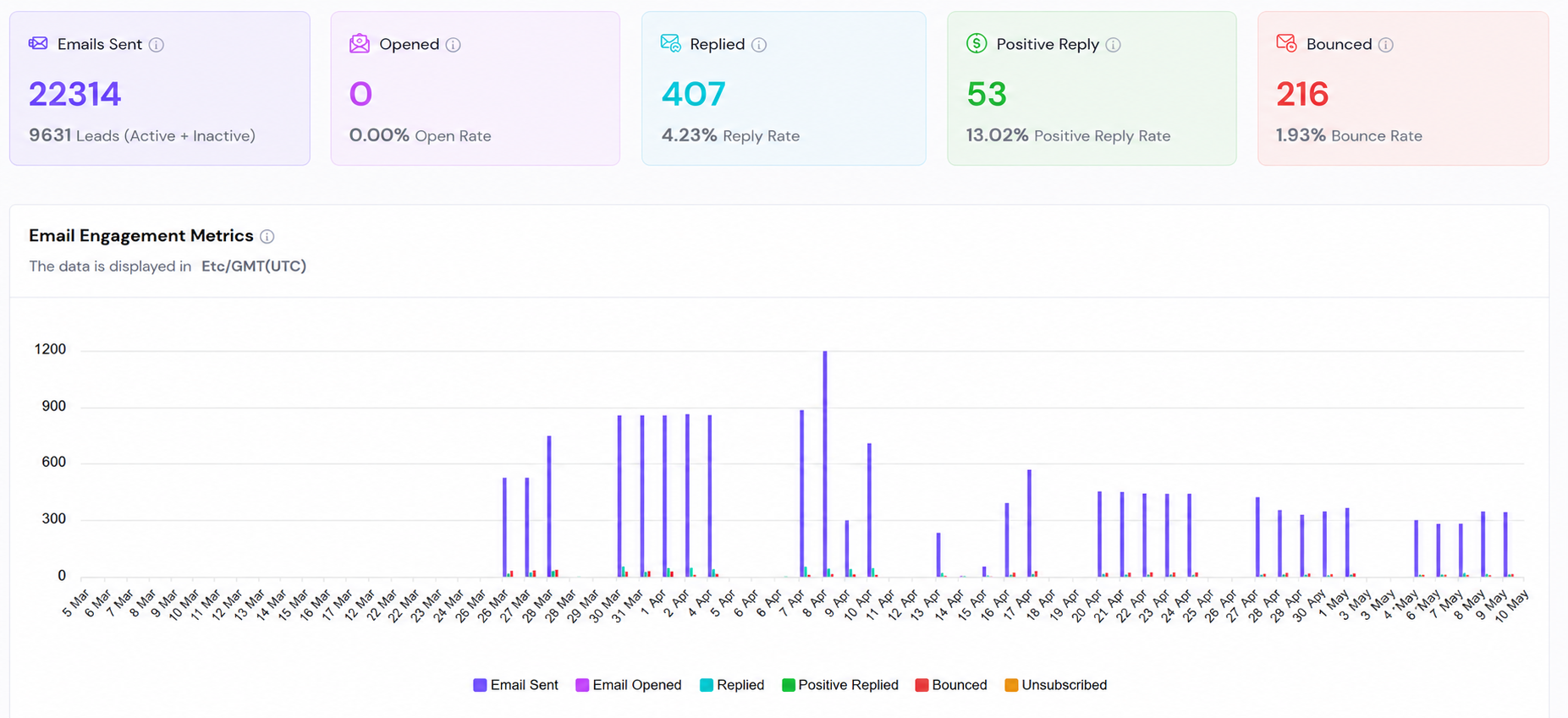
Smartlead campaign dashboard for International Flight Support showing 22,314 emails sent, 9,631 verified aviation leads, 407 replies, 53 positive responses (13.02% positive reply rate), and 1.93% bounce rate across a 46-day multi-region campaign window from 25 March to 10 May 2026.
53 qualified aviation conversations across 30+ countries in 46 days.
A multi-region outbound system built for International Flight Support, sustaining inbox placement and operator-relevant messaging across airlines, charter operators, FBOs, and MROs in Africa, Asia, Europe, the Middle East, and Latin America.
Client Overview
Company: International Flight Support
Industry: Aviation Industry Data, Flight Support Tools, and Aerospace Technology
Company Type: Global aviation technology and data services provider
Team Size: Mid-market commercial aviation supplier
ICP: Airlines (regional, low-cost, full-service), charter and corporate aviation operators, FBOs (fixed-base operators), MROs (maintenance, repair, and overhaul providers), ground handling firms, cargo carriers, and civil aviation authorities across emerging and established markets
Core Outcome: Operator-direct conversations with named airlines and aviation buyers across 30+ countries, sustained without deliverability decay
Goal: Build a multi-region outbound origination engine capable of reaching aviation decision-makers across multiple languages and regulatory regimes, while protecting deliverability and brand integrity in a regulated industry.
What They Tried Before (and Why It Didn't Scale)
International Flight Support already had reach in the global aviation market, but the commercial motion had clear ceilings.
Before working with us, the team relied on:
- Aviation industry events and trade shows that produced spikes in interest, not consistent pipeline
- Partnership-led growth that moved at ecosystem pace, not commercial pace
- Inbound discovery through aviation publications and search, which rarely captured operators at the moment of evaluation
- Manual outreach by commercial reps that capped quickly because of multi-region complexity
The result was predictable:
- pipeline that depended on the next conference cycle
- low coverage of non-English-speaking aviation markets
- decision-makers reached only when they happened to be inbound-ready
- no repeatable system for sustained operator conversations across regions
The challenge was not the offer or the product. It was distribution into a market spread across 30+ countries, multiple languages, and a buyer set that does not behave like SaaS or agency buyers.
International Flight Support did not need more channels. They needed a system designed for fragmented international aviation buyers.
Why Outbound Was the Right Channel for This Market
Inbound, partnerships, and trade shows had a place in the mix, but each had structural limits:
- aviation operators rarely "search" for a flight support tool until a procurement window opens
- partnerships move slowly and depend on ecosystem buy-in
- trade shows produce volume in clusters, not consistency
- decision-makers in non-English-speaking aviation markets are almost invisible to US and EU inbound campaigns
Outbound was the right channel because:
- it allowed International Flight Support to control volume and consistency across multiple regions
- it could reach operators directly, before they entered any active procurement cycle
- it enabled multi-region testing without committing to local sales hires in every market
- it built a repeatable origination engine that compounded month over month
In a market this fragmented, only outbound can produce predictable, operator-direct conversations at this scale.
What We Built (The Actual System)
1) Aviation Operator-Type Segmentation (Not Country Segmentation Alone)
Most outbound vendors treat "aviation" as one category. That fails immediately because a regional cargo carrier in West Africa does not respond to the same message as a corporate jet operator in the Gulf or an MRO in Southeast Asia.
We segmented the market by operator type first, geography second:
- commercial airlines (regional, low-cost, full-service)
- charter and corporate aviation operators
- FBOs and ground handling firms
- MROs and aviation maintenance providers
- cargo and freight operators
- civil aviation authorities and regulatory bodies
Each segment got its own positioning, language register, and qualification logic.
Operator-type segmentation was the single most important decision in the entire campaign. Country-only segmentation produces noise, operator-type segmentation produces replies.
2) Multi-Language Lead Handling and Regional Routing
Aviation is a global industry, but most outbound campaigns fail in non-English markets because they run English-only sequences and hope translations will close the gap.
We built a routing layer instead:
- English-speaking markets routed to one named lead handler
- non-English markets routed to a second handler with regional fluency
- reply qualification logic adapted to each language and cultural context
- send windows aligned to regional time zones, not the sender's
This single decision unlocked replies from operators in 30+ countries that would have been ignored under a single-language campaign. The regional handlers understood operator etiquette, reply tone, and the right pace of follow-up for each market.
A translated email is not a regional email. Regional outbound requires regional people in the reply loop.
3) AI-Assisted Personalisation Tied to Operator Context
Aviation buyers detect generic outreach instantly and filter it to spam.
We used AI-supported workflows to personalise each message based on:
- operator type, fleet profile, and primary route geography
- operational role of the contact (commercial, ops, procurement, technical)
- recent public signals such as route launches, fleet additions, or leadership changes
- regional language patterns and aviation-industry terminology
The objective was relevance, not flattery. Messages sounded like they were written by someone who had read the operator's recent ops update, not a tool spraying templates into inboxes.
AI personalisation is only valuable if it carries operator-specific signal. Generic AI output reads worse than a clean human template.
4) Deliverability Infrastructure Built for Global Send Volume
Sustaining inbox placement across 22,314 sends to 9,631 verified contacts in 30+ countries required strict infrastructure discipline.
We deployed:
- multiple warmed sending domains rotated through the campaign
- inbox provider diversification to spread risk across providers
- strict bounce control on a fragmented international data set, holding the final bounce rate at 1.93%
- segment-level deliverability monitoring so a single bad list segment could not damage the wider campaign
- list hygiene refreshes before each new segment activation
This prevented the failure mode common to global outbound campaigns: strong early traction followed by deliverability decay as soon as volume scales past 10,000 sends.
Global outbound dies on deliverability before it dies on copy. The infrastructure is the silent enabler of every reply.
5) Conversation-First CTAs and Reply Qualification
Aviation operators rarely respond to aggressive demo asks. Procurement in this industry is relationship-driven, regulated, and slow to trust unsolicited links.
Messaging avoided pressure-led calls to action and instead framed each touch around:
- operator-specific relevance, not pitch volume
- a low-friction question or open-ended next step
- timing flexibility, no calendar-heavy flows
- a trust-led tone that fit the regulated nature of the industry
Replies were then qualified and routed by handler within a defined response window, so no positive signal sat idle. Every "Meeting Booked" status in the CRM came from a conversation, not a calendar trick.
In regulated industries, the meeting is won in the third reply, not the first email. The CTA exists to earn a second message.
6) Continuous Angle Testing and Segment Iteration
Across the 46-day window, we ran multiple angles in parallel and rotated them based on reply quality, not reply volume.
Tested angles included:
- operational efficiency and flight planning value
- regulatory and compliance reliability
- regional fleet support and data coverage
- competitive comparison against incumbent providers
Underperforming angles were cut within the first reply cycle. Winners were scaled into adjacent segments. This is what kept the 13.02% positive reply rate sustained instead of decaying as the campaign matured.
What Didn't Work (and What We Avoided)
To protect reply quality and brand integrity in a regulated industry, we deliberately avoided:
- Generic SaaS-style templates that aviation operators filter on sight
- Volume-first outreach without operator-type segmentation
- English-only campaigns sent into non-English aviation markets
- Calendar-heavy CTAs that create friction with senior operator stakeholders
- Hype language and promotional claims that erode trust in regulated buyers
- Over-reliance on LinkedIn data for smaller operators where public records are unreliable
The priority was always: real aviation operator conversations, not vanity metrics.
46-day campaign window outcomes
25 March 2026 to 10 May 2026, multi-region aviation outbound across 30+ countries.
53 positive replies generated from a 9,631-lead aviation audience.
13.02% positive reply rate, well above the typical 1-3% benchmark for cold outbound.
407 total replies (4.23% reply rate) reflecting strong audience-message fit.
1.93% bounce rate held across a fragmented global data set.
Pipeline conversations active across 30+ countries in Africa, Asia, Europe, the Middle East, and Latin America.
Multi-region campaign sustained without deliverability decay for the full window.
Qualified meetings booked with
Star Air · Aero Nomad Airlines · Transavia France · LAM Mozambique Airlines · Asia Corporate Jet · Geofly
For a global aviation data provider, this created a level of operator-direct conversation flow that trade shows and partnerships could not match on their own.
Why This Worked
Several decisions, made early, drove the result:
- Operator-type segmentation that matched how aviation buyers actually differ
- A multi-language routing layer that respected language, geography, and time zone
- AI personalisation used for operator relevance, not gimmicks or flattery
- Infrastructure that sustained inbox placement across thousands of international sends
- Conversation-first messaging that fit the trust profile of aviation buyers
- Angle iteration based on reply quality, not reply volume
Outbound did not replace International Flight Support's existing commercial motion. It became the engine that consistently fills the top of the funnel with the right operators in the right regions.
Documented Outcomes
The 46-day campaign produced documented meetings with named aviation carriers across multiple regions:
- Star Air, regional commercial operator
- Aero Nomad Airlines, multi-region commercial carrier
- Transavia France, European low-cost airline
- LAM Mozambique Airlines, flag carrier, Southern Africa
- Asia Corporate Jet, corporate aviation operator
- Geofly, regional aviation services
Each meeting came from a structured operator-direct conversation, not a calendar trick or a generic outreach link. Detailed client testimonials and reference conversations are available on request as part of a qualified sales discussion.
Tools & Stack Used
Clay – aviation operator enrichment, ICP filtering, and AI personalisation workflows tuned for fragmented international aviation data
Smartlead – multi-region sequencing, inbox rotation, and deliverability monitoring across the full campaign window
Apollo – supplementary contact enrichment for non-LinkedIn aviation operators where public records are unreliable
LinkedIn + public aviation data – operator and contact validation across airlines, charter operators, FBOs, MROs, and ground handling firms
In-house aviation operator scoring layer – AI-assisted qualification engine that ranks operator-fit by segment, region, fleet profile, and operational role, refined throughout the 46-day window
In-house regional routing and enrichment workflows – automated multi-language lead handler assignment and signal-driven enrichment pipelines designed to match aviation procurement etiquette across each region
In-house campaign instrumentation – bespoke deliverability and reply-quality dashboards built specifically for the multi-region aviation campaign profile, with segment-level monitoring and daily review cadence
Key Learnings
- Operator-type segmentation beats country segmentation for aviation outbound at every stage of the funnel
- Public data on smaller operators is unreliable, layered validation across LinkedIn, ops directories, and public ATC records is non-negotiable
- Multi-language lead handling produces more replies than translated single-language templates
- Deliverability infrastructure is the silent enabler of global outbound at scale, especially across fragmented international DNS environments
- Conversation-first CTAs outperform demo-led CTAs in regulated, trust-led industries by a wide margin
- Angle iteration on reply quality, not reply volume, is what sustains a high positive reply rate as a campaign matures
When This Approach Is (and Isn't) a Fit
This model works best for:
- Global aviation, aerospace, and flight support providers with multi-region commercial ambition
- B2B data, SaaS, and tooling firms selling into airlines, charter operators, FBOs, or MROs
- Multi-region commercial teams that cannot scale local sales hires fast enough
- Companies with a defensible offer in a fragmented international market
- Aviation buyers where procurement is relationship-driven and regulated
It is less suitable for:
- Single-country aviation suppliers with under 200 target accounts
- Firms relying entirely on aviation industry events and trade shows for pipeline
- Teams unwilling to invest in operator-type segmentation, language coverage, and multi-region routing
- Offers without measurable operational or commercial value to airlines and operators
Next Steps
The system is now being expanded through:
- Deeper segmentation across cargo, MRO, and government aviation sub-verticals
- Additional regional language coverage where reply volume justifies it
- Layered intent signals including route launches, fleet changes, and regulatory updates
- Tighter qualification logic to convert positive replies into structured commercial pipeline conversations
- Account-level expansion within accounts already engaged across multiple operator stakeholders
The focus is on scaling without losing the operator-relevant tone that drove the 13.02% positive reply rate.
For more examples across global B2B outbound, see our services overview. Related case studies: Deltex BV (multi-region expansion beyond the Netherlands) and Merritt Healthcare Advisors (regulated B2B outbound at scale).
Outbound for aviation, answered
How does outbound lead generation work for aviation and flight support companies?
Aviation outbound works when the system is segmented by operator type (airlines, charter, FBOs, MROs, cargo, civil aviation authorities) rather than treating aviation as one category. Messages are personalised by operator type, regional context, and operational role. Replies are routed to handlers fluent in the recipient's language and time zone. International Flight Support generated 53 positive replies across 30+ countries in 46 days using this approach.
What positive reply rate can aviation B2B companies expect from cold outbound?
Well-built aviation outbound campaigns typically generate a 10 to 15 percent positive reply rate when the system uses operator-type segmentation, multi-language routing, AI-assisted personalisation, and disciplined deliverability infrastructure. International Flight Support sustained a 13.02 percent positive reply rate across 22,314 sends to 9,631 verified aviation contacts over 46 days. Generic SaaS-style outbound campaigns in aviation typically convert below 3 percent.
How long does it take to see results from outbound for aviation companies?
Most aviation outbound campaigns produce qualified replies within 30 to 60 days when the foundation is built correctly. International Flight Support generated 53 qualified aviation conversations within a 46-day campaign window. Setup time before first send is typically 2 to 3 weeks for domain warming, list segmentation, infrastructure configuration, and angle testing.
How is aviation outbound different from generic B2B cold email?
Aviation outbound differs from generic B2B cold email in three ways. First, segmentation is by operator type (airlines, charter, FBOs, MROs, cargo, regulators) rather than by company size or industry alone. Second, multi-language lead handling is essential because aviation buyers exist in 30+ countries with different languages, time zones, and procurement cultures. Third, CTAs are conversation-led and trust-first, not demo-led, because aviation procurement is regulated and relationship-driven.
What are the most common mistakes in aviation cold outbound?
The most common mistakes are: treating aviation as a single category instead of segmenting by operator type, running English-only campaigns into non-English aviation markets, using generic SaaS-style templates that aviation operators filter on sight, relying on calendar-heavy demo CTAs in a regulated relationship-driven industry, scaling volume past 10,000 sends without warmed sending infrastructure (which causes deliverability decay), and over-relying on LinkedIn data for smaller operators where public records are unreliable. Each of these failure modes was deliberately avoided in the International Flight Support campaign.
Is outbound a good fit for aviation, aerospace, and flight support companies?
Outbound is a strong fit for aviation, aerospace, and flight support companies with multi-region commercial ambition and identifiable buyers (airlines, charter operators, FBOs, MROs, cargo carriers, civil aviation authorities). It is less suitable for single-country aviation suppliers with under 200 target accounts, firms relying entirely on industry events for pipeline, or offers without measurable operational or commercial value to operators.
How does aviation outbound compare to industry events, trade shows, and partnerships?
Industry events, trade shows, and partnerships have a place in aviation pipeline but each has structural limits. Trade shows produce volume in clusters during the conference cycle, not consistency throughout the year. Partnerships move at ecosystem pace, not commercial pace, and depend on partner buy-in. Inbound through aviation publications rarely captures operators at the moment of evaluation. Outbound is the channel that lets aviation companies control volume and consistency across multiple regions, reach operators directly before they enter active procurement cycles, and build a repeatable origination engine that compounds month over month. Most successful aviation companies use outbound as the consistency layer alongside events and partnerships, not as a replacement.
How do you choose the right outbound agency for aviation or aerospace?
Evaluate against six criteria. First, segmentation depth: does the agency segment by operator type (airline, charter, FBO, MRO, cargo, regulator) or just by industry? Second, multi-language capability: do they have lead handlers fluent in the regions you need to reach? Third, deliverability infrastructure: do they run warmed sending domains, inbox provider diversification, and segment-level monitoring? Fourth, regulated-industry experience: have they handled the trust and compliance requirements of aviation procurement? Fifth, conversation-led messaging: do they use trust-first CTAs or aggressive demo asks? Sixth, documented results in adjacent regulated industries (healthcare M&A, private equity, compliance-heavy B2B) signal they understand high-trust outbound.
What tools are needed to run multi-region outbound for aviation?
Multi-region aviation outbound typically requires a Smartlead-class sequencing platform with inbox rotation and deliverability monitoring, a Clay-class enrichment platform for operator-specific data, an Apollo-class supplementary database for non-LinkedIn operators, custom regional routing logic to assign multi-language lead handlers by segment, and custom qualification logic to score operator-fit by region and operational role.
How can aviation companies sustain deliverability when sending to thousands of international inboxes?
Sustaining deliverability across thousands of international aviation contacts requires multiple warmed sending domains rotated through the campaign, inbox provider diversification across major inbox providers to spread risk, strict bounce control on fragmented international data sets, segment-level deliverability monitoring so a single bad list cannot damage the wider campaign, daily Google Postmaster reputation review across every active sending domain, and list hygiene refreshes before each new segment activation. International Flight Support held the bounce rate at 1.93 percent and sustained high inbox placement across 22,314 sends to 30+ countries, with no deliverability decay across the full 46-day window.
Build a multi-region outbound system for your aviation or B2B offer.
We build system-led outbound origination engines for global B2B teams selling into aviation, aerospace, and other fragmented international markets. Designed for consistent operator conversations and predictable pipeline.
