
The private clinic and GP group market attracts a great deal of healthtech attention, yet most digital health SaaS vendors approach it with the same system they use for hospital procurement. The result is predictable: low response rates, long silences, and demos that never turn into deals. Digital health SaaS outbound for private clinic group buyers fails at volume because the buying environment is nothing like an NHS trust. The decision-maker structure is smaller, the procurement process is informal, and the barriers to entry are lower in some respects but harder to navigate in others.
Private clinic groups and GP networks make technology decisions quickly when the right person is reached with the right framing at the right time. They make them slowly, or not at all, when the outreach treats them like a small version of a hospital. Getting this right is a positioning and sequencing problem, not a messaging volume problem.
Why does hospital-style outreach fail with private clinic group buyers?
Hospital procurement operates through formal tender processes, multi-committee approval, and defined evaluation windows. Private clinic groups operate on operational urgency and operator preference. The clinic owner or managing director is often also the clinical lead, which means the same person holds clinical, commercial, and operational accountability. There is no procurement team acting as a gatekeeper and no 12-month RFP cycle. There is a busy operator who will either see your message as immediately relevant or will not reply.
The failure mode for digital health SaaS vendors is running a hospital-style multi-touch sequence on an operator who needs a very different conversation: direct, specific about the operational problem being solved, and respectful of the fact that they are running a patient-facing business with limited administrative overhead.
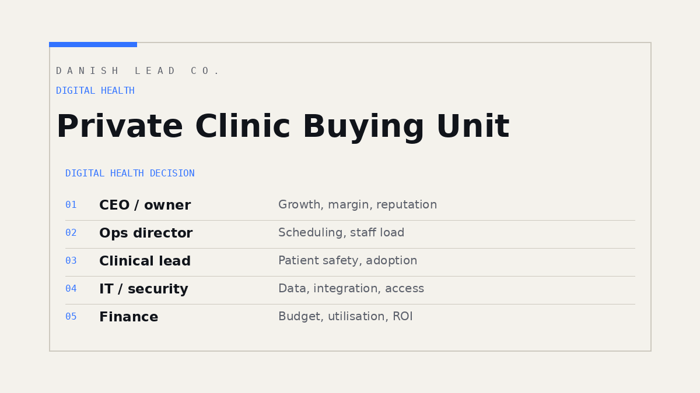 A buying-unit diagram for digital health vendors selling into private clinic groups.
Who makes technology decisions in a private clinic group?
The decision-maker profile varies by group size, but three roles matter most:
- The clinic owner or managing director. At groups of two to ten sites, this person holds final commercial authority. They care about operational efficiency, patient retention, staff productivity, and regulatory compliance. They have used too many technology platforms that promised to solve all four and delivered on none.
- The operations manager or group operations director. At larger groups of ten or more sites, an operations manager typically owns the day-to-day technology decisions. They are practical, process-focused, and respond well to outreach that shows direct knowledge of their workflows.
- The clinical director or lead clinician. For clinical workflow tools, the lead clinician holds influence over the adoption decision even when they do not hold commercial authority. A purchase a clinical director has not endorsed tends to fail at implementation regardless of commercial approval.
What does an effective outbound system for clinic groups look like in practice?
| Dimension | Generic digital health pitch | Clinic-specific outbound system |
|---|---|---|
| Targeting | "Healthcare organisations, 5-200 staff" | Groups of 3-15 clinics, specific speciality, current software visible from job posts |
| First message | Product overview and demo request | One operational problem specific to their speciality and scale |
| Proof point | Headline customer logo | Outcome for a comparable clinic group with a similar operational problem |
| Buyer addressed | Generic "healthcare decision-maker" | Named clinic owner or operations director by role and context |
| Follow-up | Automated day 3, day 7, day 14 | Manual day 5, day 12, each adding a specific operational insight |
The right system is built around the reality of how clinic group decisions are made, not around the CRM sequence that was designed for a different buyer type.
How should a digital health SaaS vendor sequence outreach to clinic groups?
Digital health SaaS outbound for private clinic group buyers works best when it follows a structured five-step system rather than a generic sales sequence.
- Build a targeted account list by speciality, group size, and technology signal. Your ICP for this market is not "private clinic." It is "five-site dermatology group using a practice management system you can integrate with." The specificity of this list determines everything downstream. Job posts signal live technology gaps. LinkedIn profiles of operations staff name the systems they manage.
- Research each account for operational context. CQC inspection reports are publicly available and surface compliance concerns directly. Job posts signal capacity problems (a patient coordinator vacancy) or reporting gaps (a data analyst vacancy). Recent press mentions show which operational priorities the group is investing in.
- Open with a problem-first message addressed to the owner or operations director. Four to five sentences. Acknowledge the speciality and scale. Name the operational failure mode your product prevents. Ask one direct question about whether that problem is live for them. No product pitch, no demo request.
- Follow up with a relevant operational insight, not a feature. One additional message, timed one week later. Include a brief observation about a trend affecting their speciality and note how your platform responds to it. This message establishes you as an operator who understands their market, not just a vendor chasing a reply.
- Qualify the conversation before proposing a demonstration. When you receive a reply, treat the first call as discovery. Understand the technology environment, the urgency of the problem, and who else would need to be involved. A qualified conversation at this stage saves months of unproductive follow-up with groups that are "interested" but have no active evaluation underway.
Which proof points actually move private clinic group decision-makers?
Clinic owners and operations directors respond to outcomes tied to metrics they already measure: patient no-shows, staff hours per appointment, regulatory compliance time, and revenue per clinician. They are not moved by analyst reports or enterprise logo lists. They are moved by evidence that another clinic group, similar to theirs in speciality and scale, solved the exact operational problem they have.
At Danish Lead Co., we have seen this pattern hold across healthcare investment clients: specificity of proof beats breadth of claim at every stage of the buying process. Our healthtech and healthcare outbound practice is built on this same principle of matching proof points to the concerns of each specific buyer type.
Regulatory credibility matters too. Private clinic operators care about CQC compliance, data governance under UK GDPR, and clinical governance implications of any system they introduce. A brief reference to your information governance framework in the right message earns more credibility than a features list.
Danish Lead Co. holds a 5.0 rating across 32 client reviews, built in part on the discipline of matching proof points to buyer context rather than defaulting to generic social proof.
How do you measure outbound performance in a fragmented market?
The right leading indicators for digital health SaaS outbound for private clinic group buyers are qualified conversation rate, account engagement rate, and decision-readiness qualification rate, not open rates or immediate pipeline value.
Private clinic groups are a fragmented market with thousands of potential accounts, inconsistent technology readiness, and varying buying windows. Measuring outbound by closed revenue will consistently undervalue the effort required in this market. Revenue from a relationship you opened today may arrive in four to six months.
- Qualified conversation rate: Of contacts reached, how many became genuine discovery conversations with a decision-maker who has budget authority?
- Account engagement rate: Across the full sequence, how many accounts engaged at any point? Single-touch non-responses hide whether the sequence structure or the messaging is the problem.
- Decision-readiness rate: Of the groups you spoke with, how many were in an active evaluation window, as opposed to passively interested?
Explore our outbound services or book a strategy session to understand how we build and run these measurement frameworks for healthtech clients.
Conclusion
Digital health SaaS outbound for private clinic group buyers requires a system built around the reality of how clinic operators make decisions, not adapted from enterprise or hospital sales playbooks. The buyers are accessible, operationally driven, and responsive to messaging that speaks directly to a problem they recognise. The system that reaches them consistently combines precise targeting, problem-first messaging, and a qualification-first approach to replies. That system is not complicated. It is simply different from what most vendors are currently running. See how we build it.