
Most freight tech SaaS vendors run high-volume outreach and measure their results by open rates and reply rates that tell them very little about qualified pipeline. Freight tech SaaS outbound for 3PL operations directors is not a volume problem. Operations directors at third-party logistics providers are reachable, but they respond only to vendors who demonstrate a working knowledge of their operational environment. The vendors who consistently open qualified conversations do it with precise targeting, operationally fluent messaging, and a follow-up system that adds value rather than chasing a response.
This playbook covers how to build that system: targeting criteria, messaging structure, sequence design, and the qualification discipline that separates active evaluators from accounts that will not move for 18 months.
Why does standard vendor outreach miss 3PL operations directors?
The 3PL operations director spends the majority of their working day managing exceptions: late carriers, warehouse capacity constraints, customer SLA escalations, and driver availability issues. Their attention is on operational flow, not vendor evaluation. When vendor outreach arrives, it competes with all of that.
The failure mode is almost always the same: a generic message about "streamlining logistics operations" or "improving supply chain visibility" that could have been sent to any operator anywhere. The operations director reads it, recognises it as a pitch that required no knowledge of their specific environment, and ignores it. The message was not wrong. It just did not cost anything to send, and that comes through.
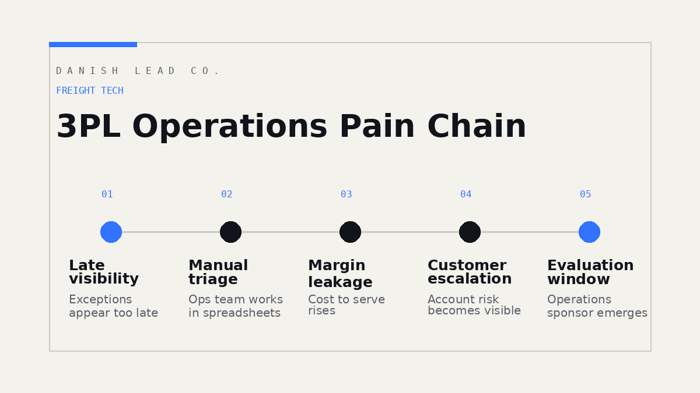 A pain-chain diagram for freight-tech SaaS teams targeting 3PL operations directors.
Which targeting criteria define the right 3PL prospect for a freight tech vendor?
The right criteria are fleet scale, technology stack signals, vertical specialisation, and ownership structure, in that order.
- Fleet and warehouse scale. Your product delivers the most ROI at a specific scale. A TMS built for 200-vehicle networks is not the right product for a 20-truck regional operator. Define the lower and upper bound of the fleet or warehouse footprint where your pricing model makes commercial sense for both sides.
- Technology stack signals. Job posts referencing specific legacy systems signal which platforms the 3PL is looking to move away from. LinkedIn profiles of IT staff name the systems they currently manage. These signals distinguish an account mid-evaluation from one locked into a long-term contract.
- Vertical specialisation. A cold chain 3PL has completely different operational requirements from a retail fulfilment 3PL or a heavy industrial carrier. Messaging that speaks to "logistics" generically lands nowhere. Messaging that speaks to chilled-lane compliance or reverse logistics for e-commerce reaches an operations director immediately.
- Ownership structure. PE-backed 3PLs are under pressure to standardise technology across portfolio companies, which creates defined evaluation windows. Independent owner-operated 3PLs move slower but are more accessible through direct outreach and less likely to route you through a central procurement process.
What messaging actually resonates with operations directors at 3PLs?
| Dimension | Generic vendor approach | Operations-fluent approach |
|---|---|---|
| Opening line | "We help logistics companies improve efficiency" | "Running mixed-fleet routes across your network without re-keying at handover is a solvable problem" |
| Pain framing | Features and integrations | Specific failure modes: detention charges, SLA penalties, driver reconciliation time |
| Proof point | Industry award or customer logo | Outcome for a comparable 3PL with a similar operational problem |
| Call to action | "Book a 30-minute demo" | "Is this the kind of problem you are actively looking to solve this year?" |
| Follow-up | Automated reminder at day 7 | Manual note at day 10 with a relevant operational benchmark |
The operations director you are trying to reach is not evaluating vendors for entertainment. They are operating under margin pressure, customer SLA commitments, and driver availability constraints. Your message earns a response when it costs you something to send: real knowledge of their environment, translated into a specific operational observation.
What does a complete outbound sequence for a freight tech vendor look like?
Freight tech SaaS outbound for 3PL operations directors works best when it follows a structured six-step playbook built around operational credibility rather than product volume.
- Define the ICP by fleet scale, vertical specialisation, and technology gap. A tighter list at higher research quality will consistently outperform a broad list at low personalisation quality. The goal is 30-50 accounts per outreach cycle where you can genuinely personalise every message, not 500 accounts where you cannot.
- Research each account for operational context before writing a single message. Job posts signal live pain: a hiring post for a dispatch coordinator signals a capacity problem; a post for a data analyst signals a reporting gap. The 3PL's customer list (visible from case studies or press coverage) signals which verticals they serve and the operational constraints that come with them. Fifteen minutes of research per account produces personalisation no generic sequence can replicate.
- Open with a problem-first message, not a product pitch. Four to five sentences. Reference the 3PL's specific context: their vertical, fleet size, or a visible technology gap. Name the operational failure mode your product prevents. Ask one direct question about whether that problem is live for them right now. No features, no demo request.
- Follow up with an operational insight, not a feature highlight. One follow-up message, seven to ten days later. Include a brief observation about a relevant trend affecting their segment: carrier rate volatility, ELD mandate enforcement changes, e-commerce returns complexity. Note how your platform addresses it. This message builds credibility as an operator who understands their market rather than a vendor chasing a response.
- Thread the operations director and the IT contact separately. At 3PLs of meaningful scale, there is typically a Head of IT or systems lead alongside the operations director. A brief, separate thread addressing integration architecture, implementation timeline, and data migration speaks to the concerns that will block a deal later if not addressed early. When the operations director passes you to IT, your name is already known there.
- Qualify the conversation before proposing a demonstration. When you receive a reply, treat the first call as discovery, not a sales call. Understand the current system, the severity of the operational pain, who else is involved in the decision, and what the evaluation timeline looks like. A qualified conversation at this stage saves months of unproductive pursuit of accounts that are "interested" but have no active evaluation underway.
How do you handle long evaluation cycles in freight tech sales?
Distinguish between three types of accounts: those actively evaluating technology now, those passively aware of a problem but not yet in evaluation mode, and those locked into a long-term contract with no near-term decision. Your follow-up cadence should reflect this: active evaluators warrant monthly contact, passively interested accounts warrant a quarterly touchpoint with no commercial pressure, and locked-in accounts go into a low-frequency nurture track until their contract window opens.
The outbound system opens the conversation. The commercial cycle runs its own timeline. Measuring outbound by closed revenue in a market with 6-12 month evaluation cycles creates pressure to inflate pipeline with unqualified accounts and compress timelines that cannot realistically be compressed.
Danish Lead Co. has delivered consistent qualified-conversation results in B2B markets with long evaluation cycles. A manufacturer booked 94 qualified buyer conversations in under two months through the same discipline: precise targeting, operationally fluent messaging, and a qualification-first approach to replies. The product and sector are different; the system architecture is identical. See how we build outbound infrastructure for B2B SaaS vendors.
We hold a 5.0 rating across 32 client reviews built on this approach: measuring the right things, reaching the right people, and building systems that work while the sales team focuses on active pipeline.
Conclusion
Freight tech SaaS outbound for 3PL operations directors that is built on operational fluency will consistently outperform volume-first sequences in this market. The operations directors you need to reach are not hard to find. They are hard to reach with a message that has not earned their attention. Precise ICP definition, problem-first messaging, a parallel IT thread, and a qualification-first approach to replies are the structural changes that convert a frustrating outreach process into a reliable source of qualified conversations with the right decision-makers.
Explore our logistics sector outbound services, see the full services overview, or book a strategy call to discuss how this system could be built for your specific freight tech market.