
EV charging outbound for fleet managers is one of the most underestimated B2B sales motions in the renewables sector. The infrastructure category is growing fast, but the outbound discipline required to sell it is not software sales, not equipment tender response, and not inbound marketing. It is a multi-stakeholder sales motion aimed at buyers who move slowly, have complex procurement rules, and are often not actively looking for a vendor when you first reach them.
This playbook covers how to structure a repeatable outbound system for EV charging infrastructure vendors: who to target, how to sequence messages across the buying committee, and what messaging angles hold up under procurement scrutiny.
Why are corporate fleet operators a high-value target for EV charging vendors?
Corporate fleet operators are high-value targets because their electrification decisions are capital commitments, not subscriptions. A fleet manager converting 50 vehicles to electric does not switch providers the following year. The contract lifetime value is significant, renewal is sticky, and one reference client opens adjacent deals in the same sector. This is why EV charging outbound for fleet managers, done with proper targeting, produces a higher return per conversation than broad sector prospecting.
The difficulty is that fleet operators are not software buyers. They are infrastructure buyers. Budget cycles are longer, approval chains involve facilities, finance, and sometimes the board, and the technical evaluation phase is thorough. Outbound has to reflect this, which means building a system designed for a six-to-twelve month sales cycle, not a thirty-day SaaS trial.
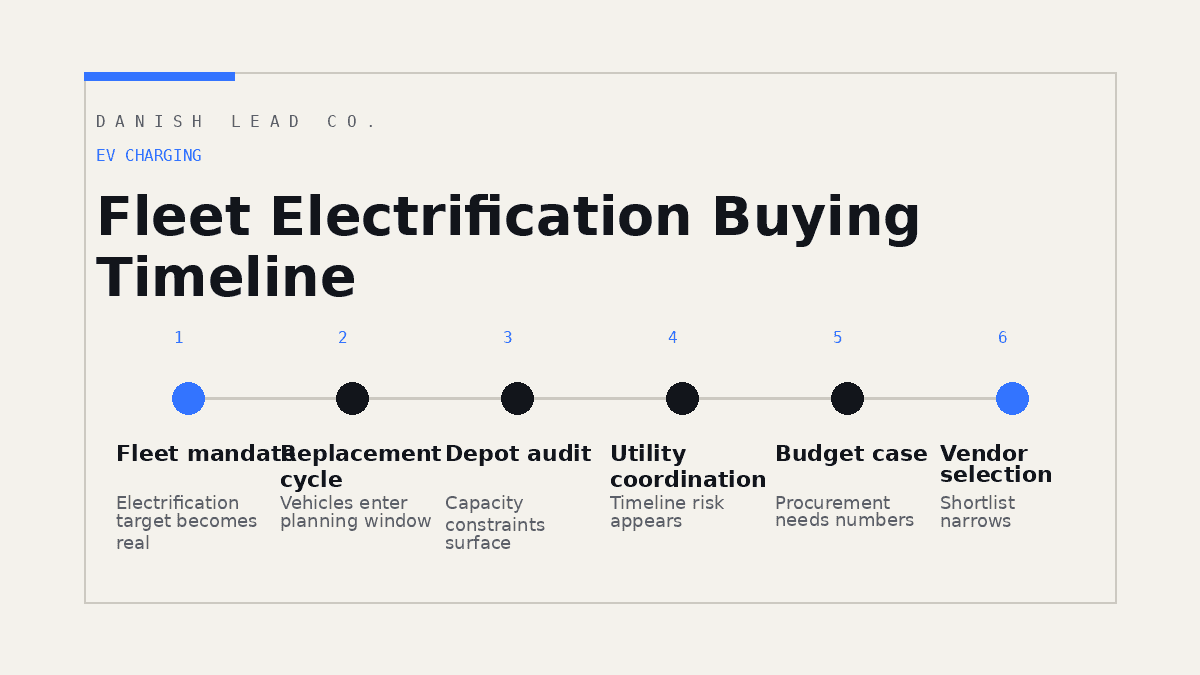 A trigger timeline showing when EV charging vendors should reach fleet managers.
Who exactly makes the buying decision on fleet EV charging infrastructure?
The buying committee for fleet EV infrastructure is typically four people, and reaching only one of them is a common reason outbound stalls.
- Fleet manager or fleet operations director. The operational champion. They understand the problem (range anxiety, depot logistics, driver behaviour) but rarely have unilateral budget authority above a certain threshold.
- Facilities or estates manager. Controls the physical environment where chargers will be installed. A hard veto if the site assessment process is not handled correctly in early conversations.
- CFO or finance director. Evaluates the total cost of ownership against the existing fuel model. Responds to financial framing rather than operational or sustainability language.
- Sustainability or ESG lead. An internal champion in larger organisations where Scope 1 emissions reduction is a board-level commitment. Can sponsor a project upward but rarely owns the budget.
Outbound sequences that reach only the fleet manager will hit a wall at budget sign-off. Sequences that reach only the CFO will meet resistance from operations. The highest-converting approach runs parallel tracks to the fleet manager and the finance lead from the start, with messaging calibrated to each.
How do different buyer personas respond to EV charging outreach?
| Persona | Primary concern | Message angle that lands | What to avoid |
|---|---|---|---|
| Fleet manager | Operational reliability, depot disruption | Uptime guarantees, phased rollout, driver adoption | Technical specifications in first message |
| Facilities manager | Site assessment, installation complexity | Turnkey installation, structural compatibility | Promising a timeline before site survey |
| CFO / Finance director | Total cost of ownership, payback period | Fuel cost delta, incentive stacking, financing options | Sustainability language as primary hook |
| ESG / Sustainability lead | Scope 1 reduction, reporting | Emissions data, certifications, reporting integration | ROI-only framing |
The most effective first-touch messages lead with the concern specific to that persona, not a product feature. A fleet manager does not care that your charger has 150kW output until they understand you will not disrupt their overnight depot cycle during installation.
What does an effective outbound sequence look like for EV charging vendors?
A well-structured outbound system for EV charging outbound for fleet managers runs across five to seven touches, with at least three follow-ups after the initial message. Danish Lead Co. internal data across 442 campaigns shows that over 52% of qualified positive replies come from follow-up messages rather than the initial touch. For infrastructure sales with long evaluation cycles, this proportion is likely higher.
The sequence below is designed for a primary track targeting the fleet operations buyer.
- Initial message: operational pain hook. One paragraph. Reference something specific about their fleet (size, sector, depot locations if identifiable). Name the operational friction EV transition creates: overnight charging windows, mixed fleet complexity, driver range anxiety. Offer one concrete piece of evidence that you have solved this before. Link to a relevant case study or reference.
- Follow-up 1 (day 5): financial framing. Shift to the cost angle. What does fuel spend look like versus a phased EV transition at current electricity tariffs? Keep it directional, not a detailed proposal. Ask if finance is already involved in the evaluation.
- Follow-up 2 (day 12): social proof. A brief reference to a comparable fleet operator (by size and sector, not named if under NDA) who has completed a similar transition. What the outcome was, how long it took, what the main operational concern was.
- Follow-up 3 (day 20): site assessment offer. A no-commitment ask: a site assessment call to understand whether the depot infrastructure is compatible with the charging spec they would need. This reframes the conversation from "are you interested in our product" to "let us help you understand your options."
- Final touch (day 30): close the loop. A short note acknowledging that timing may not be right. Ask if there is a better point in their procurement cycle to reconnect. Offer to send a single-page briefing for internal circulation.
What messaging angles work for different fleet operator segments?
Fleet operators are not a homogeneous group. The right angle depends heavily on the operator's sector, fleet size, and where they are in their electrification planning.
Large logistics and distribution fleets (100+ vehicles). These operators are already under Scope 1 pressure from large retail or FMCG clients. The compelling angle is procurement compliance: your customers are asking about your emissions plan. The outbound message should reference supply chain sustainability pressure and the timeline risk of deferring infrastructure investment.
Public sector and local authority fleets. Budget cycles are fixed and predictable. The angle is grant and incentive stacking: what central government funding exists, how your installation timeline aligns with their budget window, and what the application process looks like. These buyers respond well to a structured process framing.
Mid-market commercial fleets (20-100 vehicles). The concern is capital exposure. Leasing structures, managed service contracts, and pay-per-use charging models remove the upfront barrier that causes mid-market fleet operators to defer. Message around the difference between a capital purchase and an operational cost.
Construction and plant hire fleets. A segment where electrification is slower but where early movers are motivated by fuel theft, maintenance costs, and remote site power. The angle is operational cost reduction rather than sustainability, and the message should acknowledge that EV transition for heavy equipment is a longer horizon project.
How do you handle the long sales cycle in infrastructure procurement?
The structural challenge for EV charging outbound for fleet managers is that procurement timelines are measured in quarters, not weeks. This creates a common mistake: vendors run a short outbound burst, get no immediate response, and conclude the channel does not work. The conclusion is wrong. The system is just not built for the buyer's natural cycle.
The right response to a long sales cycle is not a longer sequence but a smarter re-engagement system. Tag prospects who opened, replied, or visited your site. Build a re-engagement track that runs at 60 and 90 days post-sequence with a different angle and updated social proof. Infrastructure buyers who are not ready in month one are often ready in month six, and the vendor who has maintained a relevant presence is the one who gets the call.
Danish Lead Co. structures these longer-cycle systems for clients in capital goods and infrastructure sectors. A solar energy firm running an equivalent outbound programme closed $1.3M in 60 days from a system that ran continuously rather than in campaign bursts. The same principle applies to EV charging infrastructure.
For fleet operators with complex procurement requirements, it is also worth building a parallel track to their procurement or fleet management consultancy if one is involved. Consultants who influence vendor shortlists are often reachable via outbound and respond well to an early relationship before the RFQ stage.
What does a complete EV charging outbound system require?
For vendors serious about building a repeatable outbound function, these are the operational requirements.
- ICP definition by fleet segment. Document company size, vehicle count, sector, and electrification stage (none, planning, partial, advanced). Separate lists for each segment enable personalised messaging at scale.
- Buying committee mapping. For each target account, identify the fleet manager, facilities contact, and finance lead before sequence launch. Multi-threaded outbound to the full committee outperforms single-contact approaches.
- Sector-calibrated messaging library. Build a message set for logistics, public sector, mid-market commercial, and construction separately. One generic message for all fleet types will underperform across all of them.
- Technical validation sequence. A separate sequence for prospects who have engaged but stalled, focused on site assessment or a technical Q&A call. Removes the "we're not sure if our depot is compatible" objection.
- Re-engagement cadence. A 60-day and 90-day re-engagement track for prospects who did not convert in the initial sequence but showed interest signals. Capital infrastructure buyers rarely decide in the first touch window.
Conclusion
EV charging outbound for fleet managers is a high-return outbound motion when it is built correctly. The category mistake most vendors make is applying a short-cycle, software-style outreach approach to a buying process that runs over months and involves four stakeholders. The fix is a system built around the actual procurement behaviour: multi-threaded from the start, sequenced for a longer cycle, and equipped with a re-engagement track for the buyers who are six months away from being ready.
To see how Danish Lead Co. builds outbound systems for companies in the renewables and infrastructure sectors, visit our renewables practice or read our case studies. For a conversation about what a system would look like for your business, book a call. You can also find more about our approach across sectors on our services page and about us.