
Legaltech SaaS outbound for general counsel is one of the hardest GTM problems in B2B software. General counsel are trained to identify persuasion tactics. They are time-poor, risk-averse, and protected by junior lawyers who pre-screen every inbound message. If your outbound system was built for a standard SaaS buyer, it will be invisible to this audience.
The good news: most legaltech vendors use identical generic messaging, which means a well-structured system that speaks directly to the GC's operational reality will stand out immediately. This playbook explains how to build that system.
Why is selling legaltech to in-house legal so difficult?
In-house legal teams are not procurement buyers in the classic sense. The general counsel is simultaneously a senior executive and a practitioner, which means they evaluate vendors through two lenses at once: does this tool reduce my exposure, and is the disruption of adopting it worth it?
Most SaaS outbound is built around ROI narratives and feature differentiation. General counsel do not buy on ROI alone. They buy on risk reduction, operational predictability, and the assurance that a new tool will not create new liability. Your messaging must address those concerns before it mentions efficiency gains.
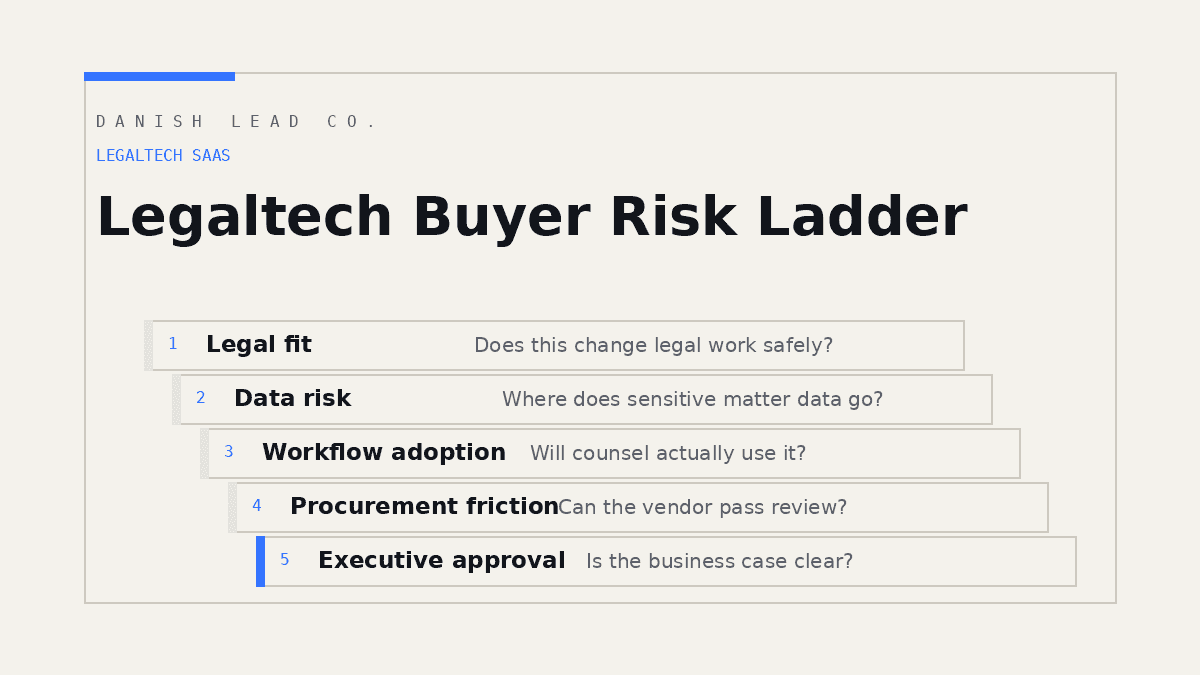 A risk-ladder diagram for legaltech SaaS vendors selling to general counsel and legal operations teams.
Who actually buys legaltech inside large organisations?
The decision process varies significantly by company size, and understanding the internal buying structure before you reach out is the single most important piece of research in legaltech sales.
| Organisation size | Primary buyer | Key influencer | Decision timeline |
|---|---|---|---|
| Under 500 employees | General counsel (GC) | CFO | 4-8 weeks |
| 500-2,000 employees | GC + legal ops lead | IT + procurement | 8-16 weeks |
| 2,000-10,000 employees | Legal ops director | GC as approver | 16-28 weeks |
| Enterprise (10,000+) | Legal ops / CLO | Multi-stakeholder committee | 6-18 months |
In mid-market companies (500-2,000 employees), the legal ops lead is often a better first conversation than the GC directly. Legal ops leaders are actively looking for tools that increase throughput, and they have the context on what the GC needs to champion a vendor internally before a formal evaluation begins.
What messaging actually works with general counsel buyers?
GCs respond to specificity and credibility. They do not respond to claims like "streamline your legal workflow" or "automate contract review." Every legaltech vendor says some version of that.
What works is messaging that demonstrates genuine understanding of the buyer's operational context:
- Regulatory exposure framing. Name the specific compliance obligation or risk category your product addresses. A GC managing data privacy obligations in a manufacturing business has very different concerns from one overseeing M&A documentation at a PE-backed SaaS company.
- Peer reference signals. GCs talk to other GCs. A reference from a peer organisation in the same sector carries more weight than any case study PDF.
- Concise problem statements. The most effective outbound messages to in-house legal are under 80 words, name a specific pain point, and end with a single yes/no question.
- No urgency language. Manufactured scarcity or time pressure permanently damages credibility with this audience.
What does an effective legaltech SaaS outbound system look like?
A systematic approach outperforms ad-hoc outreach every time when targeting general counsel. The Danish Lead Co. Legaltech Outbound Framework uses five steps:
- Build the right target list. Filter by company size, industry vertical, and recent trigger events (fundraising rounds, M&A activity, new market entry, regulatory notices) that create legal demand spikes. LinkedIn Sales Navigator filtered by "General Counsel" and "Head of Legal" provides the account pool; the trigger-event layer provides precision.
- Map the internal buying structure before contact. For companies over 500 employees, identify whether a legal ops function exists before you approach the GC. If it does, start with legal ops. If not, the GC is your first contact.
- Write persona-specific opening messages. Each message should reference a specific business event at the target company and connect it to the concrete operational problem your tool addresses. Generic multi-touch sequences do not work with this audience.
- Use a multi-channel sequence with restraint. Email and LinkedIn, three to four touches over 10-14 days. After that, pause and re-engage after 90 days with fresh context. GCs have long memories; over-sequencing damages the relationship before it begins.
- Qualify before the demo. The most expensive thing in legaltech sales is a 45-minute product demonstration with a buyer who has no budget authority. Build a qualification conversation into the sequence before the product is shown.
How long does legaltech SaaS outbound take before qualified conversations begin?
Most legaltech SaaS vendors see the first qualified conversations from a new outbound system within 6-10 weeks. The first three weeks are spent building the list, finalising messaging, and running initial sequences. Weeks 4-6 typically yield the first replies. Weeks 6-10 produce the first conversations with buyers who have genuine near-term intent.
Longer decision timelines are the norm in enterprise legal (16-28 weeks from first conversation to signed contract), but the outbound system's job is to surface buyers with active intent now, not to force conversion in a single cycle.
For context, Danish Lead Co. helped a B2B SaaS company add $72,000 in new ARR in under two months using a focused outbound system targeting a similarly technical and sceptical buyer persona. The structural principles transfer directly to legaltech.
What response rates should legaltech vendors expect from GC outbound?
Benchmarks depend heavily on list quality, messaging precision, and target segment. What is consistent: legaltech SaaS outbound for general counsel buyers produces lower raw reply rates than outbound to commercial or operations buyers, but the qualified conversion rate from those replies is considerably higher. A GC who responds is almost always worth the conversation.
A poorly targeted, generic sequence to a broad GC list will produce negligible results. A well-researched, specific sequence to a curated list of 200-300 accounts typically produces 15-25 qualified conversations per quarter.
This is consistent with results we see across B2B SaaS outbound engagements and with the platform case study referenced above. You can review our broader track record on the case studies page.
What mistakes do legaltech vendors most commonly make?
Three consistent failures appear across legaltech GTM motions:
- Targeting GCs at companies too small to have a legal budget. Below around 200 employees, the GC role is often part-time or outsourced. The threshold for an in-house legal budget that can absorb a new SaaS tool is typically 300-500 employees.
- Sending product-feature messaging instead of operational pain messaging. Features belong in the demo, not in the first outbound touch.
- Over-sequencing. More than four touches in a 14-day window will result in a permanent block. This audience expects professional restraint, not persistence.
Conclusion
Legaltech SaaS outbound for general counsel works when the system is built specifically for this persona: precise list construction, short and specific messaging, multi-channel patience, and rigorous qualification before the product is demonstrated.
The GC's scepticism is not a barrier. It is a filter that removes every competitor using generic sequences. A system built to pass that filter creates a direct line to one of the most valuable buyer personas in B2B software.
If your current setup was not built for this audience, our team at Danish Lead Co. can design the system from the ground up. We work with B2B SaaS companies that need outbound infrastructure for complex, senior buyer personas. Book a strategy conversation to discuss your legaltech GTM situation.