
Most offshore wind developers have a commercial pipeline problem that goes unacknowledged. The project pipeline is visible: turbine orders, environmental permits, grid connection agreements. The commercial pipeline, structured access to the utility procurement teams that sign long-term power purchase and offtake agreements, is far less systematic. Offshore wind outbound for utility procurement teams is the discipline that closes that gap, building a repeatable process for opening qualified conversations with procurement decision-makers at utilities rather than waiting for conferences, referrals, or the RFP cycle to create the opportunity.
This playbook covers who to target, what to say, which channels to use, and how to sequence a programme that gives an offshore wind developer predictable access to utility buyers. For a broader view of how we support renewable energy businesses, see the Danish Lead Co. renewables page.
Why do offshore wind developers struggle to fill their commercial pipeline with utility buyers?
The fundamental challenge is that utility procurement decisions move on long timescales and within tightly controlled internal processes, which makes event-based networking and cold introductions unreliable. A developer who meets a procurement manager at an industry conference cannot know whether that contact has active budget authority, relevant decision-making mandate, or a procurement cycle that aligns with any near-term opportunity.
Three factors compound the commercial pipeline problem:
- Procurement cycle opacity. Utility power purchase and capacity agreements involve legal, grid, finance, and executive stakeholders. Knowing where a utility sits in its procurement cycle is not public information, and conference conversations rarely surface it.
- Relationship concentration. Most developers rely on a small number of existing utility relationships, which concentrates revenue risk and limits growth to the pace of natural network expansion.
- Conference dependency. Industry events create irregular, expensive exposure to buyer contacts. A developer who cannot attend three major events per year is competing at a structural disadvantage before any conversation starts.
A structured outbound system removes the dependency on all three of these constraints.
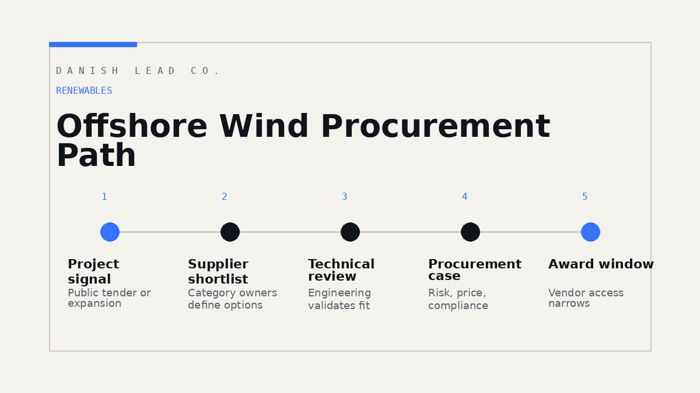 A procurement-path diagram for vendors approaching utility buyers in offshore wind.
Who actually makes the procurement decision at a utility company?
Procurement decisions at utilities are distributed across three layers. The first is the commercial development or power procurement team, which originates and evaluates supply agreements. The second is the regulatory and grid affairs function, which assesses technical and compliance compatibility. The third is CFO or executive leadership, which approves commitments above a defined contract threshold.
For an offshore wind developer, the primary outreach target is the commercial development director or power procurement director. This is the person with the authority to decide that a conversation is worth having and the internal standing to champion a prospective supplier across other stakeholder functions. Reaching them requires outreach that speaks to commercial outcomes and supply security, not project specifications.
What does a utility procurement manager need to see before agreeing to a meeting?
Utility procurement managers agree to a meeting with an offshore wind developer when they see three things in the initial outreach: evidence of relevant project scale and readiness, a clear signal that the developer understands the utility's specific procurement context, and a low-friction reason to spend 30 minutes on a call.
What does not work is feature-led outreach about turbine technology, carbon credentials, or environmental impact metrics. Procurement managers evaluate commercial and contractual viability. Technology is assessed separately, later in the process, by a different team. Outreach that opens with MW capacity or carbon certificates speaks to the wrong part of the decision and signals a vendor who has not done their homework on how procurement actually works at a utility.
How do the main outreach approaches for wind developers compare?
The table below compares the four most common approaches offshore wind developers use to access utility procurement teams.
| Approach | Pipeline Predictability | Time to First Meeting | Cost | Dependency |
|---|---|---|---|---|
| Conference networking | Low | 3-9 months | Very high | Event calendar |
| RFP-reactive only | Very low | 6-24 months | Low | Utility's timeline |
| Relationship-only | Medium | 6-18 months | Medium | Existing network |
| Structured outbound | High | 4-8 weeks | Medium | Target list |
Structured outbound is the only approach that gives a developer control over timing and contact selection. The other three create pipeline by waiting. The Danish Lead Co. case study for a solar energy developer shows what structured outbound produces in the renewables sector: $1.3M closed in 60 days from a programme built around direct outreach to qualified buyers.
What is the six-step offshore wind outbound system?
The following framework is the operational structure of an effective offshore wind outbound for utility procurement teams programme. Each step builds directly on the previous one.
- Define the procurement target universe. Identify utilities by geography, power mix, regulatory regime, and publicly available procurement history. A focused list of 50 to 150 well-qualified utilities is more valuable than a broad list of 500 undifferentiated ones.
- Map decision-maker layers per utility. For each target utility, identify the commercial development director, the relevant procurement or grid integration contact, and the executive approver. This three-layer map ensures your programme never depends on a single relationship at any account.
- Write position-led message sequences per stakeholder tier. Commercial development messaging opens with supply security and contract terms. Executive messaging opens with strategic energy portfolio logic. Neither should open with technology features or project certifications.
- Launch a sequenced outreach programme. Run three to four touchpoints per contact over a four-to-six week window. Each message takes a distinct angle from the previous one. The sequence closes with an honest note rather than an indefinite follow-up loop.
- Handle multi-stakeholder threads with full context. When one stakeholder responds positively, update the messaging to other contacts at the same utility to reflect the active conversation. Siloed outreach creates confusion and damages the credibility of the developer's brand at that account.
- Convert conversations to commercial progression. The objective of the first conversation is a second, more structured meeting with the right stakeholders present. Build a specific follow-up plan for each engaged utility before the first call ends.
This is the playbook we apply at Danish Lead Co. for energy and renewables clients. It functions as a system for building pipeline rather than a substitute for the conference circuit.
How do you handle multi-stakeholder procurement decisions at utilities?
Multi-stakeholder procurement decisions at utilities require parallel outreach to different contacts with messages calibrated to each contact's specific role and concern. The commercial development director cares about supply terms, developer track record, and contract structure. The grid and regulatory team cares about technical interconnection viability and permitting status. The executive cares about portfolio risk and long-term price certainty.
Sending the same message to all three contacts does not work. Neither does waiting for one stakeholder to introduce you to the others. A structured programme runs three threads simultaneously with coordinated but distinct messaging, and the sequencing is updated in real time as any thread generates a response.
For offshore wind developers with active projects across multiple markets, this multi-threaded approach also allows simultaneous outreach to utilities in different geographies without creating message overlap or mixed signals about the developer's positioning. Our outbound services page covers how we structure multi-market programmes for energy clients. You can also review our case studies for worked examples, or book a call to discuss your specific market and procurement targets.
Conclusion
Offshore wind outbound for utility procurement teams is not a short-term fix for a slow conference calendar. It is a structural change in how a developer accesses commercial pipeline. The developers who build the most consistent access to utility procurement managers operate an outbound system that runs independently of events, incumbency, and existing relationships.
The combination of trigger-based targeting, position-led messaging, and multi-threaded stakeholder sequencing gives an offshore wind developer what most currently lack: predictable, structured access to the procurement decision-makers who sign the long-term agreements that underpin project finance and growth.